Riga vs Tallinn: which Baltic capital is right for you?
Two countries in one day: day trip from Riga to Tallinn
Duration: 14 hours
- Hotel pickup
- Long day trip
Should I visit Riga or Tallinn?
Pick Riga if you want cheaper prices, more architectural variety (Art Nouveau + Baroque + Soviet), and a more authentic local atmosphere. Pick Tallinn if you want a more compact, medieval-postcard Old Town that's slightly easier to navigate. If you have 5+ days, do both — they're 4 hours apart by bus (€15–25).
| Choose Riga for | Art Nouveau architecture, cheaper prices, more day trips by train |
| Choose Tallinn for | A more intact medieval Old Town, Finland/Scandinavia connections |
| Distance apart | 310 km, about 4 hours by bus (€15–25) |
| Price difference | Riga runs 20–30% cheaper across accommodation, food and drinks |
| Best for both | Trips of 5+ days combining the two on one Baltic itinerary |
The two capitals: a genuine comparison
Riga and Tallinn are 310 km apart. Both are medieval Hanseatic port cities on the Baltic Sea. Both are EU and Schengen members operating on the euro. Both have UNESCO-listed Old Towns. Both punch well above their weight for food, architecture, and day-trip access to national parks and coastal landscapes.
They are also genuinely different cities with different characters, different strengths, and different weaknesses. This comparison is honest: we name what each city does better and where each falls short.
Architecture: Riga is more varied, Tallinn is more intact
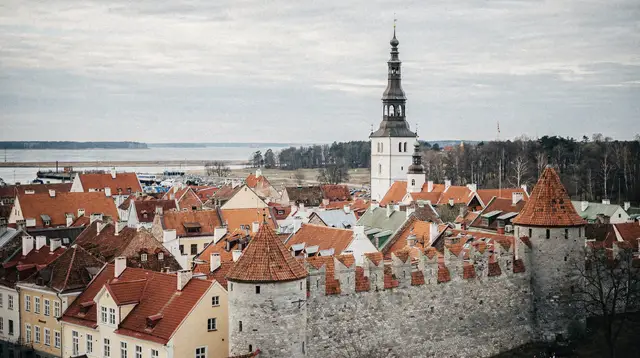
Tallinn has one of the most intact medieval Old Towns in Northern Europe. Toompea hill with its limestone towers, the Gothic Town Hall, the 13th-century Old Thomas weather vane, the cobbled streets largely unchanged in layout since the Hanseatic period — it is a coherent medieval cityscape that is genuinely extraordinary.
Riga has the most Art Nouveau architecture of any city in the world. The Quiet Center district (Alberta iela, Elizabetes iela, Strēlnieku iela) contains approximately 800 Art Nouveau buildings designed between 1898 and 1913. Add to this a substantial Old Town with Baroque, Gothic, and Classicist buildings, the Soviet-era Academy of Sciences, and the Central Market in repurposed Zeppelin hangars — and Riga is more architecturally varied, if less uniformly medieval.
Verdict: For medieval atmosphere, Tallinn is more intact and more visually consistent. For architectural breadth and especially for Art Nouveau specifically, Riga is unrivalled anywhere in Europe.
Old Town scale and vibe
Tallinn’s Old Town is roughly 60 hectares — compact, walkable in a few hours, and densely concentrated with the key sites (Toompea Castle, Alexander Nevsky Cathedral, Town Hall Square). In summer it is very crowded, particularly the top of Toompea hill.
Riga’s Old Town is larger and more sprawling, with a greater variety of character across different sections. The area around Town Hall Square is more tourist-facing and busier; the medieval walls section near the Swedish Gate and the Three Brothers is quieter; the residential lanes near the Riga Castle have genuine neighbourhood character.
Verdict: Tallinn is easier to navigate and its highlights are more concentrated. Riga rewards more exploration but can feel less cohesive. For a one-day first impression, Tallinn is more immediately satisfying. For a two-day or longer stay, Riga’s variety holds up better.
Prices
Riga is cheaper, consistently. Here are real 2026 comparisons:
| Category | Riga | Tallinn |
|---|---|---|
| 3-star hotel (summer peak) | €80–120/night | €100–150/night |
| Mid-range restaurant main | €12–18 | €15–22 |
| Local beer (bar) | €3–5 | €4–6 |
| Bolt/taxi (standard trip) | €4–8 | €5–10 |
| Museum entry (typical) | €5–10 | €6–12 |
| Coffee (cafe) | €2.50–4 | €3–5 |
Riga is approximately 20–30% cheaper across all categories. For a budget-conscious trip, this is a meaningful difference over 4–5 days.
Food scenes
Both cities have strong food cultures. The differences:
Riga: Stronger for traditional Baltic/Latvian cuisine — the Central Market is extraordinary, and the authentic restaurant scene (Folkklubs Ala, Lido, Pelmeni XL) has no equivalent in Tallinn in terms of breadth and price. The coffee culture is also more developed, with several excellent independent roasters (Rocket Bean Roastery being the benchmark).
Tallinn: More international in food character, with a stronger Nordic-influenced fine dining scene. Leib Resto ja Aed and Pädaste Manor (day trip) are the reference points for Estonian fine dining at a level that Riga’s finest (Vincents) matches but the surrounding scene doesn’t match as deeply. Tallinn’s Telliskivi food market is better curated than anything comparable in Riga.
Verdict: Riga for traditional food at accessible prices. Tallinn for Scandinavian-influenced fine dining.
Day trips
Riga wins this category definitively.
From Riga, all by public transport:
- Jūrmala: 20 minutes by train, under €4. Baltic beach resort.
- Sigulda: 1 hour by train, €3. Medieval castle ruins, bobsleigh track, Gauja National Park hiking.
- Cēsis: 2 hours by train, under €4. Medieval town, castle, national park access.
- Rundāle Palace: 1.5 hours by bus, comparable to Versailles in ambition.
From Tallinn, most day trips involve driving or private cars — the Estonian train network is less useful for day-trip tourism than Latvia’s. Lahemaa National Park (1 hour by car) is superb but requires renting a car or booking a tour.
Verdict: Riga is significantly better for independent day-trip travel by public transport.
Connectivity (getting there)
Riga Airport (RIX) has strong connections from the UK (particularly Ryanair from Edinburgh, Manchester, Birmingham, Bristol, and London Stansted), from Western and Central Europe, and from Scandinavia. Flights are often cheaper than Tallinn equivalents.
Tallinn Airport (TLL) is well connected from Scandinavia and Finland (strong Helsinki connection via ferry too) but has fewer direct UK routes than RIX.
Verdict: Riga has better budget airline access from the UK. Tallinn is more accessible from Finland and Sweden.
Weather differences
Both cities have similar continental-maritime climates, but Tallinn is slightly more exposed to Baltic Sea winds — it is a coastal city in a way Riga (on the Daugava River, 15 km from the sea) is not. In summer, Tallinn can be noticeably windier and cooler than Riga on days when Riga is warm and pleasant.
Winters are comparable: cold, grey, and dark, with better snow cover in both cities than Western European equivalents.
Who should choose which city
Pick Riga if:
- You want more architectural variety, particularly Art Nouveau
- Budget matters (Riga is consistently cheaper)
- Day trips by public transport are important to your plan
- You’re interested in Soviet history and heritage
- You want the Central Market and a genuine urban-market food culture
Pick Tallinn if:
- You want the most intact medieval cityscape in the region
- You’re arriving from or continuing to Finland by ferry
- You want a Scandinavian-flavoured city (culturally closer to Helsinki than Riga is)
- You prefer a more compact, navigable Old Town
- Fine dining is a priority and you’re willing to pay Nordic prices
Do both if:
- You have 5+ days in the Baltics
- You’re doing a broader Baltic capitals trip
The Lux Express bus between Riga and Tallinn runs multiple times daily and takes 4 hours for €15–25. If you have the time, the combination is greater than the sum of its parts — each city gives context to the other.
For a structured tour that visits both, the two countries in one day tour from Riga to Tallinn (€135) is a long day but covers the key points. For a more comfortable pace, the Explore the Baltics Riga-Tallinn trip with stops (€155) adds sightseeing breaks en route. If you’re doing a one-way transfer between the cities, the private transfer from Riga to Tallinn with a Pärnu city tour includes a stop in Pärnu along the way.
The honest verdict
Both cities are among the most interesting city-break destinations in Northern Europe. Neither is a consolation prize for failing to book Paris or Amsterdam — each is a genuine destination with world-class architecture, an excellent food scene, and surroundings that reward further exploration.
If forced to choose: Riga has more layers to explore, stronger day-trip options, lower prices, and the Art Nouveau district, which is literally unique in Europe. Tallinn has a more immediately impressive medieval core and a slightly more polished tourist infrastructure.
For a first visit to the Baltics with limited time (3–4 days), Tallinn is slightly easier to get the most from quickly. For a longer or more independent trip, Riga has more to offer.
For a full side-by-side including Vilnius, see our three Baltic capitals 7-day trip guide.
If you pick Riga: what to build the trip around
Riga’s day-trip advantage is the single strongest reason to give it more time than Tallinn on a Baltic itinerary. Sigulda and the Gauja National Park is an hour away by train and covers medieval castle ruins, hiking, and the summer bobsleigh in a single day. Jūrmala is 20 minutes away for a Baltic beach afternoon.
Rundāle Palace, Latvia’s baroque showpiece, is roughly 1.5 hours out and one of the most underrated palace visits in Northern Europe. None of these have a real Tallinn equivalent reachable this easily by public transport. For the city itself, start with a structured Old Town walking route before branching into the Art Nouveau district.
Getting the most from Riga’s architecture
Because Art Nouveau is the main reason to pick Riga over Tallinn, it deserves a proper plan rather than a quick look. Start with the Riga Art Nouveau architecture guide to understand what you are looking at, then walk the Alberta and Elizabetes street route at your own pace. If you prefer someone to point out the details, a guided walk through the Art Nouveau streets saves you from staring at facades without knowing why they matter. The Art Nouveau district page shows how the neighbourhood fits together, and the Mikhail Eisenstein buildings tour is the best follow-up for the most extravagant frontages.
Tallinn simply has no counterpart to this. Its strength is a single medieval silhouette; Riga’s strength is that every few streets look like a different century. That difference is worth keeping in mind when you decide how many days each city gets.
Choosing where to sleep and eat in Riga
If Riga wins your vote, the next question is the base. Our comparison of the Old Town versus the Art Nouveau area as a place to stay helps you decide between atmosphere and calm. For meals, where locals eat in Riga is a better starting point than the restaurants around the main squares, and the overpriced Old Town restaurant list tells you which ones to skip. Food is one of the clearest places where Riga earns its reputation against Tallinn, so it is worth giving it real time.
Planning a combined Riga and Tallinn trip
Doing both cities rewards a little preparation, because the bus ride between them takes a real slice of a day. The Riga to Tallinn travel guide compares the transport options in detail, and the Tallinn day trip from Riga page explains what is realistic if you only have a single day there. For the destination itself, see Tallinn from Riga.
If your plan stretches beyond two cities, the Baltic capitals 7-day itinerary lays out a ready-made order, and the Riga versus Vilnius comparison covers the third capital. A tour such as the mini Baltic trip via Pärnu to Tallinn is another way to cover the road between them without handling the logistics yourself.
Matching the city to your travel style
Your choice often comes down to how you like to travel rather than which city is objectively better. Independent travellers who enjoy adding a train ride or a hike to a city stay will find more to do from Riga. Visitors who want a tidy, concentrated medieval centre and little planning will be happy in Tallinn. If you are not sure which type you are, how to plan a trip to Riga step by step is a useful way to test whether the city’s variety suits you.
Seasons matter too. Riga’s summer beaches and festivals are a different trip from its quiet winter streets, and the best time to visit Riga guide helps you pick a month before you commit. Whatever you choose, give each city enough days to be seen properly rather than rushing between them. A rushed trip to two cities is rarely better than a relaxed trip to one.
8 practical tips for choosing between Riga and Tallinn
- Plan 3–4 days if you only pick one city for a first Baltic visit: Tallinn gives the quickest first impression, while Riga’s variety holds up better over two days or longer.
- Budget around €12–18 for a mid-range main in Riga against €15–22 in Tallinn. Over 4–5 days of meals, that gap adds up noticeably.
- Base yourself in Riga if you want day trips without a car: Jūrmala is 20 minutes by train and Sigulda is 1 hour for €3.
- Tallinn’s best excursions, such as Lahemaa National Park (1 hour by car), need a rental car or a booked tour, so don’t expect Riga-style train access there.
- Walk Alberta iela, Elizabetes iela and Strēlnieku iela in the Quiet Center to see the roughly 800 Art Nouveau buildings designed between 1898 and 1913.
- Visit Tallinn’s top of Toompea hill early in summer, when it is very crowded, and save the quieter Swedish Gate and Three Brothers area for Riga.
- Fly into Riga if you’re coming from the UK: Ryanair serves it from Edinburgh, Manchester, Birmingham, Bristol and London Stansted, often cheaper than Tallinn equivalents.
- Combining both cities means at least 2–3 days each. Buses leave Riga International Bus Station next to Central Market, but not hourly, so check the Lux Express timetable first.
Frequently asked questions about Riga vs Tallinn
Is Riga or Tallinn cheaper?
Which city has a better Old Town, Riga or Tallinn?
How do you get from Riga to Tallinn?
Which is better for day trips — Riga or Tallinn?
Which city has better nightlife — Riga or Tallinn?
Is Tallinn or Riga safer for tourists?
Top experiences
Bookable activities with verified prices and instant confirmation on GetYourGuide.
Photos show the place, not the operator’s tour.