Latvian Ethnographic Open-Air Museum guide
Riga: Latvian Ethnographic Open-Air Museum experience
Duration: 4 hours
- Hotel pickup
Is the Latvian Ethnographic Open-Air Museum worth visiting?
Yes — one of the largest open-air museums in Europe, covering 87 hectares on the shore of Lake Jugla, with 118 historical buildings relocated from across Latvia. Entry is just €4 for self-guided visits, or €42 for a guided experience with hotel pickup via GYG. Best visited on a weekday in summer.
Latvia’s largest museum — 87 hectares and 118 original buildings
The Latvian Ethnographic Open-Air Museum (Latvijas Etnogrāfiskais brīvdabas muzejs) on the shore of Lake Jugla is the largest open-air museum in the Baltic states and one of the largest in Europe. The premise is straightforward: historical buildings of architectural and cultural significance from across Latvia — farmsteads, granaries, barns, windmills, fishermen’s houses, chapels, country inns — were physically relocated to the museum grounds and reassembled with original building materials.
The result is an 87-hectare outdoor landscape organized by region (Vidzeme, Kurzeme, Zemgale, Latgale, Rīga fishing villages, Livonian coast) that gives visitors a comprehensive picture of traditional Latvian rural architecture and life from the 17th to the early 20th century. With 118 buildings currently on site, it is genuinely possible to spend a full day here and not see everything.
The museum was established in 1924 — early enough that many buildings that would otherwise have been demolished in the 20th century were preserved. Some of the wooden structures date to the 17th and early 18th centuries and represent the earliest surviving examples of traditional Latvian vernacular architecture.
| Where | Brīvības gatve 440, ~9 km from Old Town |
| Cost | €4 self-guided, €42 GYG guided experience |
| Time needed | 3–4 hours minimum; full day for demonstrations |
| Getting there | Bus 1 (35–40 min, €1.50) or Bolt (15–20 min, €8–10) |
| Best time | Summer weekends (craft demonstrations) or Jāņi (Jun 23–24) |
The museum in sections
The site is organized into regional groupings. Walking the full circuit takes approximately 4–5 hours at a relaxed pace.
Vidzeme farmsteads: The central Latvian region is represented by a cluster of farmstead complexes — main house, granary, threshing barn, sauna (pirts) — arranged as they would have been on an original farmstead site. The interiors are furnished with period-appropriate items: carved wooden chests, woven blankets, ceramics, farming tools. Several buildings have costumed guides or craftspeople demonstrating traditional techniques.
Kurzeme fishing village: The most visually distinctive section — the Livonian fishing community’s distinctive boat-shaped dwellings and the net-drying racks along the lake shore recreate the coastal settlement pattern of Latvia’s northwest. The juxtaposition of these structures against the lake makes for excellent photography.
Latgale (eastern Latvia): The most architecturally different section — Latgale’s historically Catholic population developed distinct building traditions that differ visibly from the Lutheran west. The chapel relocated from Latgale is the most significant religious building on the site.
Windmills: Several relocated windmills are distributed across the site — Dutch-type and post mills from different regions. The mill structures are well-maintained and visually prominent above the tree line.
Fishermen’s chapel on the lake shore: The site’s most atmospheric location — a small 18th-century wooden chapel immediately on the lake waterfront, surrounded by fishing equipment and dock structures. On summer mornings, when the mist is still on the lake, this section is one of the most photographically beautiful spots in the entire Riga area.
Getting there
Bus: Route no. 1 from Rīga center (stop at Brīvības iela / Eksporta iela corner) runs to the Brīvdabas muzejs stop. Journey approximately 35–40 minutes, €1.50 (e-talons required — buy at a NARVESEN kiosk or the Rimi supermarket). Buses run every 15–20 minutes.
Bolt: Approximately 15–20 minutes from the Old Town, €8–10.
The guided tour:
Riga: Latvian Ethnographic Open-Air Museum experience — €42, 4 hoursThe GYG-organized guided visit includes hotel pickup from Riga, the museum entry fee, and a guided tour with a specialist who provides context for each building and the craft demonstrations. At €42 this is the most expensive entry in Riga’s museum landscape, but it transforms the experience from a pleasant outdoor walk into a genuinely educational immersion in Latvian rural culture.
Craft demonstrations — the best days to visit
The museum’s craft demonstrations are one of its most appealing features and are scheduled primarily on weekends from June through August. The craft calendar (available on the museum website, entmuseum.lv) shows which demonstrations are planned for each weekend:
- Weaving on traditional horizontal looms (several buildings have active looms)
- Blacksmithing in the relocated forge structures
- Pottery — traditional Latvian earthenware forms
- Bread baking in original bread ovens (the smell alone is worth the visit)
- Wool processing — spinning, carding, dyeing with natural plant pigments
The Midsummer festival (Jāņi, June 23–24) transforms the museum into its most spectacular form: bonfires, folk singing, traditional dress, and all craft stations active simultaneously. If your visit coincides with Jāņi or a summer weekend with demonstrations, the museum’s value increases significantly. See Riga Midsummer Jāņi and Līgo festival for the full picture.
Honest assessment: when to go and what to skip
Go in: June–August (full demonstrations, full opening hours, maximum atmosphere). September (autumn light on the wooden buildings, reduced crowds). May (spring greening of the grounds).
Be cautious in: October–March (many buildings closed or reduced access, demonstrations suspended, daylight limited). The open-air format requires good weather; November in particular is a difficult month to visit.
Skip: You cannot see everything — 118 buildings in a day is impossible. Focus on the regional sections that interest you most, find a couple of buildings with active demonstrations or guides, and eat the bread if it is being baked. The windmills and the lake-shore chapel are the non-negotiable stops for most visitors.
Practical information
Opening hours: May–September 10:00–20:00 daily. October 10:00–18:00. November–April 10:00–17:00 (some buildings closed, reduced access).
Entry: Adults €4, children (7–18) €2, seniors €2, under 7 free.
On-site: Several seasonal café/food points inside the museum sell traditional Latvian food — rye bread, smoked fish, soup in clay bowls. The quality is good and the prices are reasonable (lunch €7–12). Bring water for the full day.
Map: A detailed site map in English is available at the entrance (€0.50). The GYG guided tour includes the guide rather than the map.
The historical significance of the collection — why 1924 mattered
The museum was founded in 1924, only six years after Latvia’s declaration of independence. This timing was not accidental. The young Latvian state was in the process of constructing a national identity distinct from the German-Baltic, Russian, and Livonian traditions that had dominated the territory for centuries. Collecting and preserving evidence of Latvian rural life — the farmsteads, the tools, the building traditions — was explicitly part of that nation-building project.
This means the museum has a dual purpose that visitors sometimes miss. Yes, it is a record of how Latvian rural communities lived. But it is also a statement about what Latvia as a cultural entity was, separate from the German landowners, the Russian Empire, and the Livonian Order that had ruled the territory. The buildings were gathered with urgency: by the 1920s, many were already being replaced by more modern construction.
The Soviet period (1940–1991) added a complicated layer. The museum survived under Soviet administration — the communist authorities found the concept of a people’s folk museum compatible with their ideology, at least on the surface. But the Latvian national interpretation of the buildings was suppressed. The museum’s post-independence reopening in the 1990s involved recovering that interpretive layer and returning Latvian cultural context to a collection that had been reframed in Soviet terms for five decades.
Regional differences to look for
The four main Latvian regions represented at the museum are architecturally distinct in ways that are easy to read once you know what to look for.
Vidzeme (central Latvia): The farmsteads are typically organized in a loose cluster around a central threshing yard. The main house (istaba) faces south for winter light. Buildings are predominantly unpainted grey-brown timber, with thatched or wooden shingle roofs. The interiors feature the characteristic Latvian clay-plastered sauna structures.
Kurzeme (west and northwest): The Kurzeme farmsteads are more enclosed — buildings arranged in a rectangular courtyard plan, with the gates and walls providing shelter from Atlantic winds. The Livonian coastal communities (fishing villages on the northwest coast) developed a specific longhouse structure unlike anything in the inland regions.
Zemgale (south): The most fertile region of Latvia, and the farmsteads reflect the relative prosperity — larger barns, more elaborate granaries, bigger main house structures. The Zemgale buildings at the museum include some of the largest relocated structures on site.
Latgale (east): The most architecturally distinctive region. Latgale remained under Polish-Lithuanian rule longer than the rest of Latvia, and the Catholic religious tradition visible in the buildings’ roadside crucifixes, the chapels, and the interior iconography is genuinely different from the Lutheran west. First-time visitors sometimes find Latgale’s visual culture surprising within a “Latvian” context.
The Livonian fishing village — the museum’s most distinctive section
The fishing village section at the lake shore deserves its own attention. The Livonians were Latvia’s original coastal people — speakers of a Finno-Ugric language distantly related to Finnish and Estonian, now effectively extinct as a living community. Their building traditions along the northwest Latvian coast were distinct from Latvian rural architecture: the longhouse net-drying structures, the tar-smell of fishing equipment, the boat-building workshops.
The lakeside location of this section at the museum is the best possible setting for these structures. The water, the fishing tackle hung on poles, and the small wooden jetties recreate the Livonian coastal community in a way that would be impossible in an indoor setting.
Visiting with a specific interest
Architecture and design: The museum rewards visitors who move slowly and look at structural detail — the joinery methods, the saddle-notch corner joints of the log buildings, the way roof shapes vary by region. Many buildings are open and well-lit inside; the interior construction is often as interesting as the facade.
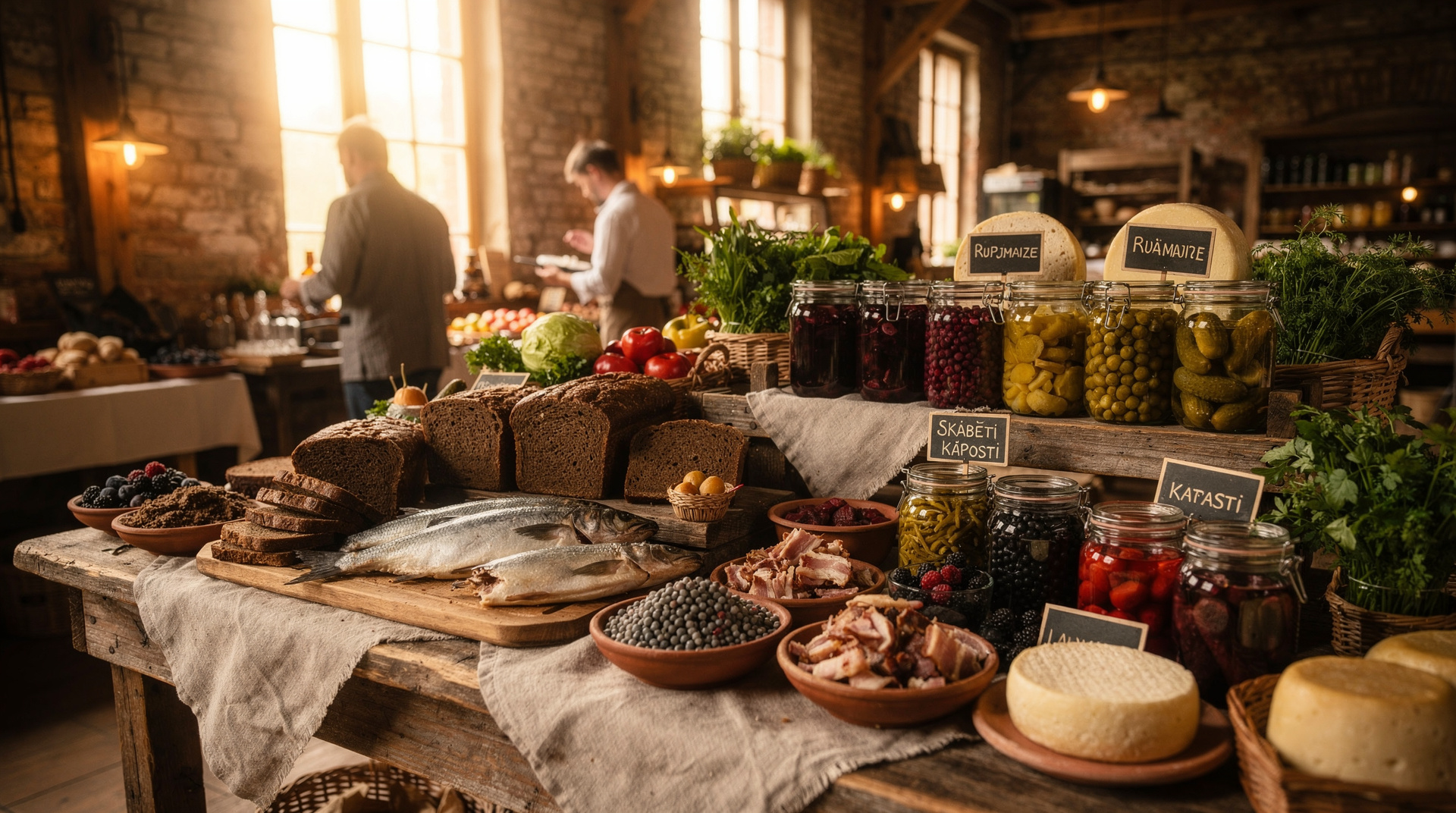
Food history: Several farmsteads have active bread-baking demonstrations in the original clay ovens. The rye bread produced at the museum is authentic — the same recipe and the same oven type that would have been standard in any Latvian farmstead before the 20th century. If bread is being baked on your visit day, buy a loaf. The combination of caraway and rye produced in a clay oven at wood-fire temperature is a genuine flavor that does not survive industrial production.
Photography: The museum’s most photogenic moments are early morning (mist on the lake through the fishing village structures), the windmill profiles against sky, and the late-afternoon light on the weathered wooden walls of the Vidzeme farmsteads. The Jāņi festival (June 23–24) provides bonfire light after dark.
Families with children: The craft demonstrations are the key. Children who would find a standard indoor museum intolerable can spend hours watching a blacksmith at the forge, watching bread being shaped before going into the oven, or watching weaving on a working loom. The open-air format means restless children can simply move to the next building without creating a problem.
How the guided tour compares to self-guided
The €42 GYG guided experience versus the €4 self-entry question comes down to a single factor: do you want the interpretive layer or not?
The self-guided visit with the site map is genuinely excellent and covers the essential buildings. The weakness is context: without a guide, the buildings are interesting but opaque. You see a well-preserved 17th-century farmstead, but you do not know how the family heated it in winter, what the layout meant about their social structure, or why the granary’s placement relative to the main house was determined by fire risk rather than convenience.
The guided tour provides that layer. For visitors who find background context enriches the experience, the price difference is worth it. For visitors who prefer to wander freely at their own pace, the €4 entry and the site map gives a satisfying 4-hour visit.
Combining with other Riga sights
The Ethnographic Museum is 9 km from the Old Town — far enough that it works best as a half-day or full-day standalone destination rather than a combination with city-center sights. One natural pairing: visit the museum in the morning, then take Bus 1 back toward the city center and stop at the Mežaparks forest park for an afternoon walk before returning to the center.
For the cultural continuity: the museum connects naturally with the Latvian history museums in the city center, which cover the political and urban history that the Ethnographic Museum contextualizes against. The rural Latvia at the museum and the urban Riga at the Occupation Museum are two halves of the same picture of what Latvia was before and during the Soviet period.
Final practical checklist
Before visiting, confirm:
- Demonstration schedule: Check entmuseum.lv for the current weekend craft calendar. If demonstrations are running, plan the visit around the scheduled times rather than arriving at a random hour.
- Weather: The open-air format is genuinely diminished in rain or cold. The museum is worth a weather-check booking decision, not a fixed commitment.
- Transport timing: Bus no. 1 runs every 15–20 minutes from the city center; the last bus back to town runs until approximately 23:00 in summer. Bolt is reliable at any hour.
- Time budget: Allow 3–4 hours minimum for a satisfying self-guided visit. If craft demonstrations or the Jāņi festival are running, allow the full day.
- Food: The on-site seasonal cafés are good but not always open in shoulder season. Bring lunch provisions in October–April to be safe.
How it fits a wider Riga culture trip
The Ethnographic Museum pairs naturally with other food- and culture-focused stops. If bread being baked on-site whets your appetite for more, best Latvian foods to try in Riga and Latvian rye bread, pelmeni and pīrāgi essentials go deeper into the specific dishes.
Families combining culture with a full day out can also check Riga with kids for how the museum sits alongside other family-friendly stops, and best time to visit Riga for how the craft-demonstration calendar interacts with the wider seasonal picture. If your Riga trip includes Midsummer, coordinate with the Jāņi and Līgo festival guide — the museum’s Jāņi celebration is one of the most complete versions of the festival available to visitors.
Who this museum is and is not for
The open-air format rewards visitors with time and genuine curiosity about rural material culture — architecture, craft, everyday domestic life before industrialisation. It is less rewarding for visitors on a tight one- or two-day Riga stay who need to prioritise the Old Town core, and less rewarding on a rushed visit, since the site’s scale means a 45-minute stop barely covers one regional section. If you only have a short window and must choose one cultural museum, compare against the Riga history museums overview for indoor alternatives that need less time and less transport.