Best Latvian foods to try in Riga: an honest guide
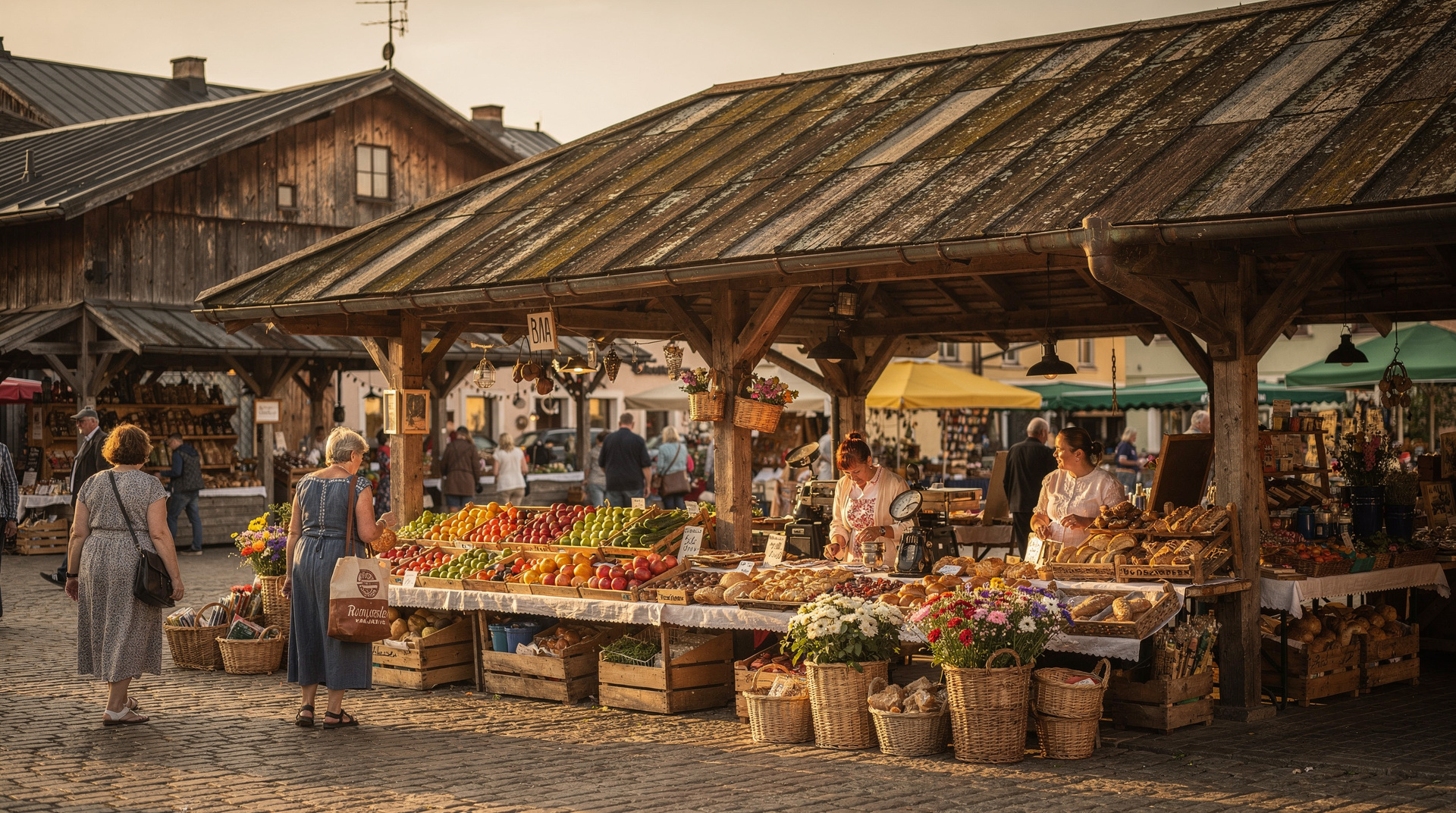
Riga: Central Market traditional food tour in a small group
Duration: 2 hours
- Tastings included
- Small group
What is the most essential Latvian food to try in Riga?
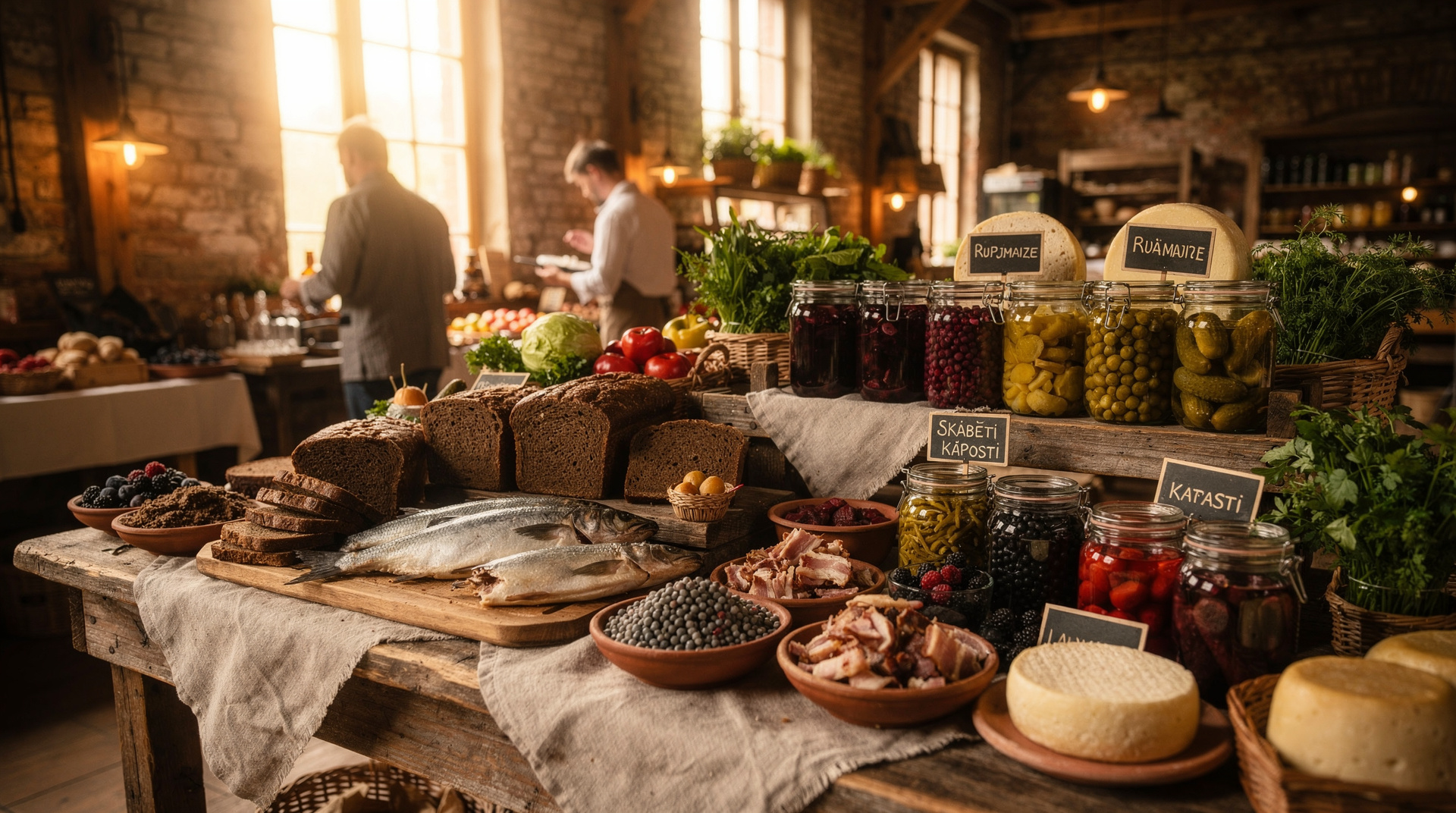
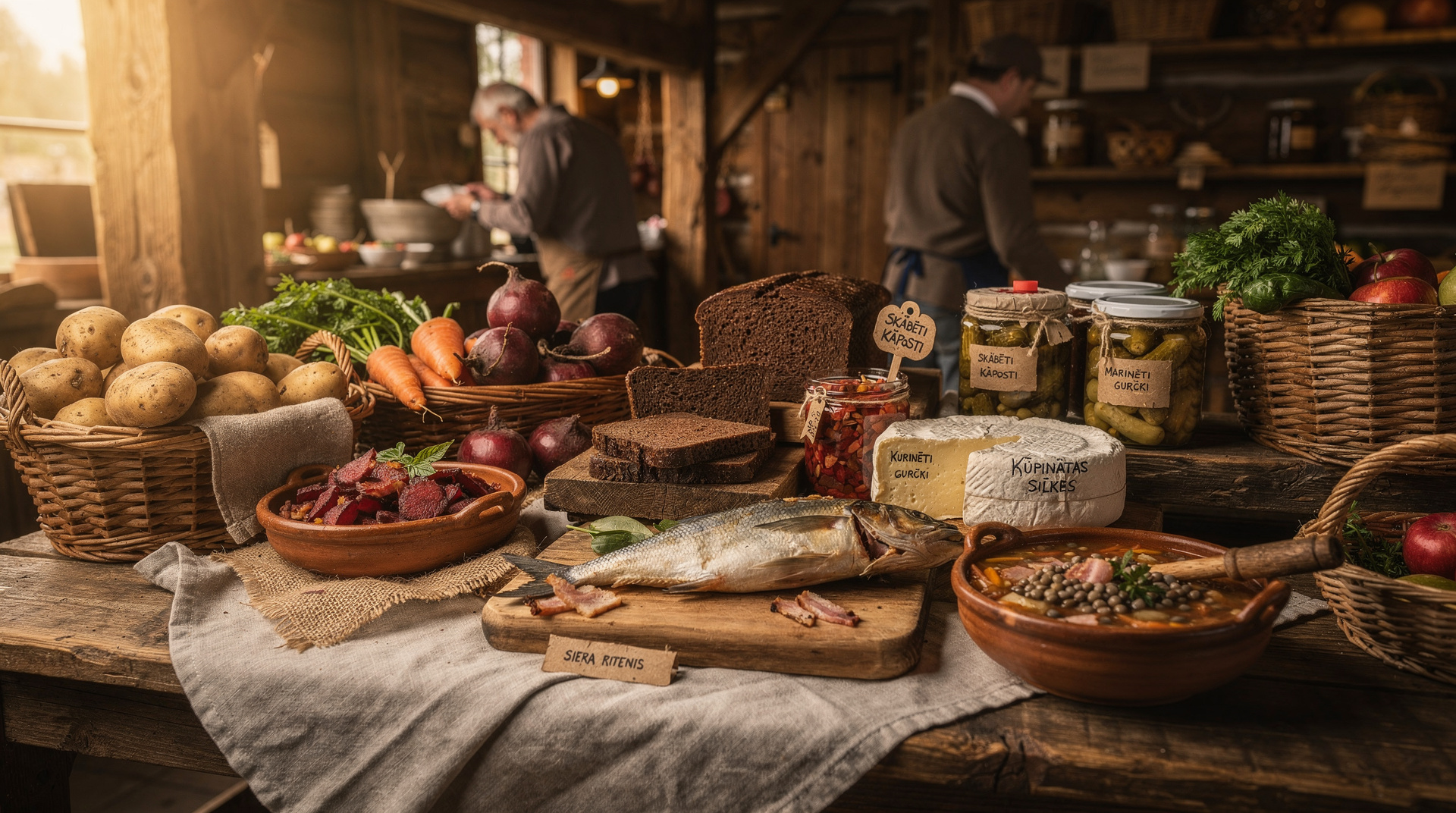
Rye bread (rupjmaize) is the single most culturally significant food in Latvia — dense, slightly sour, made with a sourdough starter, and fundamentally unlike the rye bread sold in most Western supermarkets. After that: smoked fish from the Central Market, pīrāgi (bacon-filled pastries), grey peas with bacon (pelēkie zirņi), and a cautious sip of Riga Black Balsam.
Why Latvian food surprises people
Most visitors to Riga know almost nothing about Latvian cuisine before they arrive. They expect generic Eastern European food — heavy, meaty, possibly Soviet-era cafeteria in register — and some of it is, but the best of Latvian food reflects Latvia’s position at the junction of forest, sea, and farm: cold-smoked fish from Baltic rivers and the sea, dense sourdough rye bread baked by tradition for centuries, dairy from small farms, forest mushrooms and berries gathered in season, and a range of pork preparations that reward patience and appetite.
This guide covers the foods you should actually try — not a comprehensive survey, but a focused list of things that are worth seeking out and genuinely distinctive to Latvia.
| Where | Central Market, Lido, Folkklubs Ala |
| Must-try | Rupjmaize, smoked fish, pīrāgi |
| Cost | around €1.50–8 per item/dish |
| Time needed | 1–2 hours for a proper market visit |
| Best season | Autumn for mushrooms, summer for cold soup |
Rupjmaize: Latvian rye bread
Rupjmaize (dark rye bread) is the most important single food in Latvian cuisine and culture. It is difficult to overstate this: rye bread is to Latvia what pasta is to Italy or bread baking is to France — a staple with deep cultural resonance, regional variations, and a standard of quality that Latvians take seriously.
The traditional version is made with 100% rye flour using a sourdough starter maintained over generations. It is dense — not airy — with a tight crumb that holds together under a knife, a slightly sour flavour from the fermentation, and a firm dark crust. It is designed for the Baltic climate: high caloric density, long shelf life, and complementarity with the fatty and salty foods (smoked fish, cultured dairy, bacon) that define the traditional diet.
The best place to taste it is the Central Market dairy pavilion, where several vendors sell freshly baked loaves. A good dark rye loaf costs €2–4. Eat it with butter and a piece of Latvian farmers’ cheese for context, or with smoked fish from the adjacent fish pavilion.
What to avoid: the light “rye” breads sold in Old Town tourist bakeries, which are partly wheat, much lighter in flavour, and not representative of the tradition.
Take a Central Market food tour for guided access to the best vendors (€43, 2 hours)Smoked fish: the Central Market experience
Baltic and river fish — smoked, salted, or pickled — form the backbone of the traditional Latvian diet and are still treated with genuine respect in the Central Market. The fish pavilion is worth an extended visit.
Smoked eel (smēķēts zutis) — the prestige item of Baltic smoked fish culture. Cold-smoked eel from Latvian rivers is fatty, deeply flavoured, and genuinely distinguished. Budget €3–5 for a portion. It is not cheap but it is one of the most memorable things you can eat at the Central Market.
Smoked herring (smēķēts siļķe) and smoked sprats (sprotes) — more everyday but excellent. The sprats especially — small Baltic herrings smoked golden-brown — are eaten on dark rye bread and are one of the quintessential Latvian snack combinations.
Smoked bream and perch — freshwater fish from Latvian lakes and rivers, smoked in a way that produces a drier, firmer result than the oilier sea fish. Try them if they’re there.
Grey peas with bacon (pelēkie zirņi ar speķi)
Latvia’s national dish, served at every traditional celebration from Christmas to midsummer. Dried grey peas (the Latvian equivalent of field peas, with an earthier, slightly nuttier flavour than common peas) are cooked until tender and served with fried bacon lardons — sometimes with onions, sometimes with sour cream. It is a simple dish and its quality depends almost entirely on the quality of the peas and the bacon.
Available at Lido cafeterias, Folkklubs Ala, and any restaurant that serves traditional Latvian food. Cost: €5–8 as a main course.
Pīrāgi (bacon-filled pastries)
Pīrāgi are small baked pastries — crescent-shaped or oblong, about the size of a closed fist — filled with a mixture of finely chopped smoked pork or bacon and onions, baked until golden brown. They are ubiquitous at Latvian celebrations (Jāņi, Christmas, birthday parties) and are often the thing Latvian expatriates miss most when they live abroad.
A good pīrāgis has a tender, slightly enriched yeast dough (often with egg and a little butter) and a filling that is well-seasoned and moist without being greasy. They are eaten warm but also at room temperature. The best place to find them is the Central Market (some vendors sell freshly baked pīrāgi in the morning) or at Lido.
See our full guide to Latvian rye bread, pelmeni and pīrāgi.
Cold beet soup with sour cream (aukstā biešu zupa, or aukstā zupa)
A summer dish — cold soup made from young beet greens (or sometimes beets), cucumbers, radishes, hard-boiled eggs, and kefir or buttermilk, garnished with sour cream and dill. It is beautiful to look at (deep magenta-pink), cooling on a warm day, and significantly more flavourful than the description suggests. Available in summer at most Latvian restaurants; usually €4–6 a bowl.
Cottage cheese pancakes (biezpiena pankūkas)
A simple dessert or breakfast dish — flat pancakes made with fresh cottage cheese (biezpiens), egg, and a little flour, fried until golden, served with sour cream and jam. Light, slightly tangy, and extremely good. Common at Latvian breakfast tables and at cafes throughout the city.
Kvass (kvass)
A fermented beverage made from rye bread — slightly sour, lightly carbonated, with perhaps 0.5% alcohol (not enough to classify it as beer in most countries). Cold kvass on a summer day, bought from the kiosks that appear throughout Riga in June–August, is one of the most refreshing things in the Baltic summer. Costs €1–2 per cup.
Riga Black Balsam: the honest assessment
Riga Black Balsam (Rīgas Melnais Balzams) deserves its own section because it is simultaneously the most Latvian-specific food product and the one that most reliably divides opinion.
It is a herbal liqueur, 45% ABV, produced in Riga since 1752 by Latvijas Balzams. The recipe includes approximately 24 plant ingredients — birch buds, ginger, oak bark, wormwood, nutmeg, and others — macerated in neutral spirit and sweetened with sugar and honey. The flavour is bittersweet, medicinal in the best apothecary sense, complex, and genuinely unlike anything else.
Honest verdict: not for everyone. If you dislike bitterness or medicinal flavours, neat Black Balsam will not appeal to you. If you are curious and open, try a small shot (€3–4 at a bar) rather than buying a bottle. The Black Magic Bar on Meistaru iela in Old Town is the official tasting venue and they serve small measures.
It is significantly more approachable in a cocktail — mixed with blackcurrant juice (the most popular combination in Latvia), with hot tea, or in the classic “Balsam coffee.” Most bars in Riga can make these; the Black Magic Bar has the best selection.
See our full guide to Riga Black Balsam.
Join the Flavours of Riga food and history tour (€48, 3 hours)Where to eat traditional Latvian food
Lido (Elizabetes iela 65 and other locations) — a cafeteria chain serving traditional food at honest prices (€4–8 per main course). Pelēkie zirņi, pīrāgi, meat dishes, dairy soups, and Latvian desserts. Always busy with locals at lunch.
Folkklubs Ala (Peldu iela 19, Old Town) — a cellar bar and restaurant with live folk music most evenings. Traditional food, Riga Black Balsam cocktails, reasonable prices. Genuinely popular with Latvians, not just tourists.
The Central Market canteen — a steam-table cafeteria inside the main market building, serving hot food for €3–6 a plate. No atmosphere, entirely authentic.
Pelmeni XL (Kalēju iela 7, Old Town) — Soviet-era canteen serving pelmeni for €3–5. Cash only. Queue expected.
Bergs Bazaar neighbourhood (off Elizabetes iela, New Town) — several good modern Latvian restaurants in a more sophisticated setting, including Vincents (Michelin Bib Gourmand level) and The Greenhouse (inventive Latvian seasonal cooking). Mains €15–25, appropriate for a special dinner.
For a broader overview of where locals actually eat, see our guide to Riga restaurants where locals eat. For the food tour options, see our comparison of the best food tours in Riga.
Latvian food culture: the honest overview
Before arriving in Riga expecting a rich restaurant scene built around traditional food, it is worth calibrating expectations. Latvian traditional cooking is excellent, but it is Northern European peasant food — filling, seasonal, built around preservation and storage, with a flavour profile quite different from the spiced, complex cuisines of Mediterranean Europe.
What Latvian cooking does well: fermented products (sourdough rye bread, sauerkraut, kefir, cottage cheese), smoked proteins (fish and meat), root vegetables, freshwater fish, berries and mushrooms in season, and pork in its many forms. These ingredients, prepared simply, produce honest and genuinely good food.
What Latvian cooking does not do: extensive spicing, complex sauces, elaborate technique for its own sake. The best Latvian food tastes of its ingredients — the rye bread tastes of the grain and the fermentation, the smoked fish tastes of smoke and fish, the grey peas taste of legume and bacon. This simplicity is a virtue, not a limitation, for visitors who approach it on its own terms.
The restaurant scene. Riga’s restaurant scene has developed significantly since independence in 1991, and particularly in the last decade. The best restaurants (Vincents, The Greenhouse, Miera iela’s various options) apply contemporary culinary technique to local seasonal ingredients with genuine skill. This is a long way from the traditional canteen food culture of the Soviet period. But the traditional cooking is still there — at Lido, at the Central Market canteen, at Folkklubs Ala — if you know where to look.
Seasonal eating: when to eat what
The single most important piece of advice for eating well in Riga is to eat what is in season. The ingredients available in June are entirely different from those available in November, and the best cooking at every level of the market reflects this.
Spring (April–May): Fresh herbs, early dairy, rhubarb desserts. Light preparations after the heavy winter menus. The first asparagus, imported rather than local, appears in April. Local strawberries arrive in late May.
Summer (June–August): Peak abundance. Local strawberries, cherries, and eventually blueberries and cloudberries. Fresh peas. New potatoes. The cold beet soup season — this is the one Latvian dish that genuinely depends on summer ingredients and cannot be made authentically in winter. The smoked fish is at its most varied, with freshwater species from Latvian lakes and rivers.
Autumn (September–October): The richest season for traditional Latvian cooking. Mushroom season is exceptional — the Central Market outdoor section fills with foragers selling 20–30 species in season. Root vegetables at peak. Sauerkraut begins its fermentation for the winter. The grey peas with bacon dish makes most sense in this period.
Winter (November–March): Heavy warming food. The clearest expression of traditional Latvian cooking as it developed in response to the climate. Smoked pork, preserved fish, sauerkraut, root vegetable soups, dairy-heavy desserts. The Latvian Christmas food tradition — grey peas, pork, blood sausage (asinsdesu), and gingerbread — is the clearest single expression of what Latvian traditional cooking looks like.
Foods worth buying at the Central Market
Some Latvian food products are worth buying at the Central Market to take home or to consume during your stay. A practical list:
Rye bread. The crusty, dense sourdough rye bread from good market bakers is better than anything available outside Latvia. A half-loaf costs €2–3. It keeps well for 3–4 days at room temperature and longer in a refrigerator. Buy it fresh and eat it with Latvian butter and smoked fish for the most direct experience of Latvian food culture.
Smoked fish. Vacuum-packed smoked eel, trout, or bream from the fish pavilion keeps well and travels. Check the packaging date. A small package costs €6–12 depending on the species. Smoked eel in particular has a richness and depth of flavour that differs significantly from the smoked salmon that most visitors already know.
Honey. Latvian honey — particularly the dark forest honey from lime blossom, which is characteristic of Latvia’s forest-heavy landscape — is excellent and relatively cheap at the market (€5–8 for a jar). It is one of the better food souvenirs from Riga.
Cottage cheese (biezpiens). Not suitable for travel but worth buying for in-room eating or for cooking if you have access to a kitchen. Fresh Latvian cottage cheese from a market vendor is significantly better than the commercial equivalent and is central to Latvian breakfast culture.
Experience the Central Market with a local guide — food tour, 2 hours (€43)Honest tips for navigating Riga’s food scene
Avoid the main square restaurants. The cafes and restaurants on Town Hall Square and Cathedral Square charge a significant location premium for mediocre food. The closer you are to the main tourist squares in Old Town, the worse the value. Walk 10 minutes in any direction and the quality-to-price ratio improves substantially.
The dienas ēdiens (daily menu) is excellent value. On weekdays at lunch, most Riga restaurants offer a fixed two-course menu (soup and main) for €7–12. This is how locals eat lunch, and the menus typically include the most representative daily cooking at each restaurant. Ask for the dienas ēdiens rather than the à la carte menu at lunch.
Supermarkets are not a last resort. The Latvian supermarket chains (Rimi, Maxima, Prisma) stock high-quality local products at honest prices: excellent rye breads, Latvian dairy, local craft beers, and the full range of Black Balsam products. The supermarket is a useful supplement to the market and restaurant visits, not a fallback.
Guided food tour vs going it alone
A guided food tour makes the most sense for a first visit to the Central Market, where the sheer size of the five pavilions and the lack of English signage can make independent exploration overwhelming. The Central Market food tour or the Flavours of Riga tour both solve this by taking you directly to vendors worth trusting, with tastings included in the price.
Going it alone works well if you already know roughly what you are looking for — rye bread from the dairy pavilion, smoked fish from the fish pavilion, honey from the outdoor stalls — and are comfortable pointing and gesturing where English fails. The honest trade-off: a guide costs €43–48 and saves you from wasted time and mediocre vendors, but a self-guided visit costs nothing beyond what you eat and lets you set your own pace. For a first-time visitor with only a day or two in Riga, the guided option is the more efficient use of limited time; for a longer stay, exploring independently over two or three separate visits is genuinely rewarding.
Frequently asked questions about Best Latvian foods to try in Riga
Is Latvian food vegetarian-friendly?
What is rupjmaize (Latvian rye bread)?
What does Riga Black Balsam taste like?
What are pīrāgi?
Where can I try traditional Latvian food without tourist prices?
Top experiences
Bookable activities with verified prices and instant confirmation on GetYourGuide.