Latvian cooking classes in Riga: what to expect and honest tips
Riga: Latvian food cooking masterclass with a chef
Duration: 3-4 hours
- Small group
- Meal included
Are Latvian cooking classes in Riga worth it?
Yes, if you choose the right one. The Latvian food cooking masterclass with a chef (€85, 3–4 hours) is the most authentically Latvian option — you learn to make genuine Latvian dishes from a trained chef. The market tour plus cooking class (€95, 4 hours) adds the Central Market component, making it the best value for the full experience. The khinkali/pelmeni class (€55) is good but is Georgian/Russian cooking rather than Latvian.
The cooking class landscape in Riga
Riga has three main cooking class options on GetYourGuide, and understanding what each one actually is — rather than what the marketing suggests — is important for choosing the right one.
The key distinction: Latvian cooking versus cooking that is associated with the Soviet/Baltic/Eastern European tradition but is not specifically Latvian. This distinction matters if your reason for taking a cooking class in Riga is to learn something specifically about Latvian food culture.
| Where | Central Riga / Central Market, exact venue varies by class |
| Cost | €55–95 per person |
| Time needed | 2–4 hours |
| Booking | 2–3 days ahead; 1 week for summer weekends |
| Best for | Latvian food specifically: chef masterclass or market tour |
The Latvian food cooking masterclass with a chef
Price: €85 per person Duration: 3–4 hours Group size: Small group (6–10 people) What you cook: Authentic Latvian dishes — varies by season and chef, typically including pīrāgi, grey peas preparation, a seasonal main, and dessert What you eat: The dishes you prepare Rating: 4.9 / 5 (110 reviews) Badges: Small group, meal included
This is the cooking class to book if your objective is to understand Latvian cooking. The class is led by a trained chef with a background in Latvian culinary tradition, and the dishes are chosen to represent genuinely Latvian cooking — not Soviet-era cafeteria food and not Eastern European food in general, but the specific Latvian food culture that evolved from the country’s agricultural heritage and its relationship to the Baltic landscape.
The format is hands-on: you make the food, not watch someone else make it. The meal you prepare at the end of the class is lunch or dinner, depending on the session time.
At €85, it is priced reasonably for a European cooking class with a professional chef, a 3–4 hour session, and a meal included. The 4.9 rating is very high and consistent.
Honest note: The dishes covered vary by season. A good summer class might include cold beet soup, fresh produce preparations, and lighter dishes. A winter class will more likely focus on the heavier warming foods of the traditional Latvian cold-season diet. Both are valid representations of Latvian cooking. If specific dishes matter to you, contact the operator before booking.
Book the Latvian food cooking masterclass with a chef (€85, 3–4 hours)The market tour with cooking masterclass
Price: €95 per person Duration: 4 hours Group size: Small group (typically 8–12) What you do: Guided tour of the Central Market, then cooking class using market ingredients What you cook: Latvian dishes using produce purchased on the market tour What you eat: What you cook Rating: 4.9 / 5 (85 reviews) Badges: Tastings included, cooking class
The market tour plus cooking class is the most complete single experience you can have with Latvian food culture in Riga. The structure — go to the source (the Central Market), choose the ingredients, understand where they come from and why they matter, then cook with them — is pedagogically excellent and experientially distinctive.
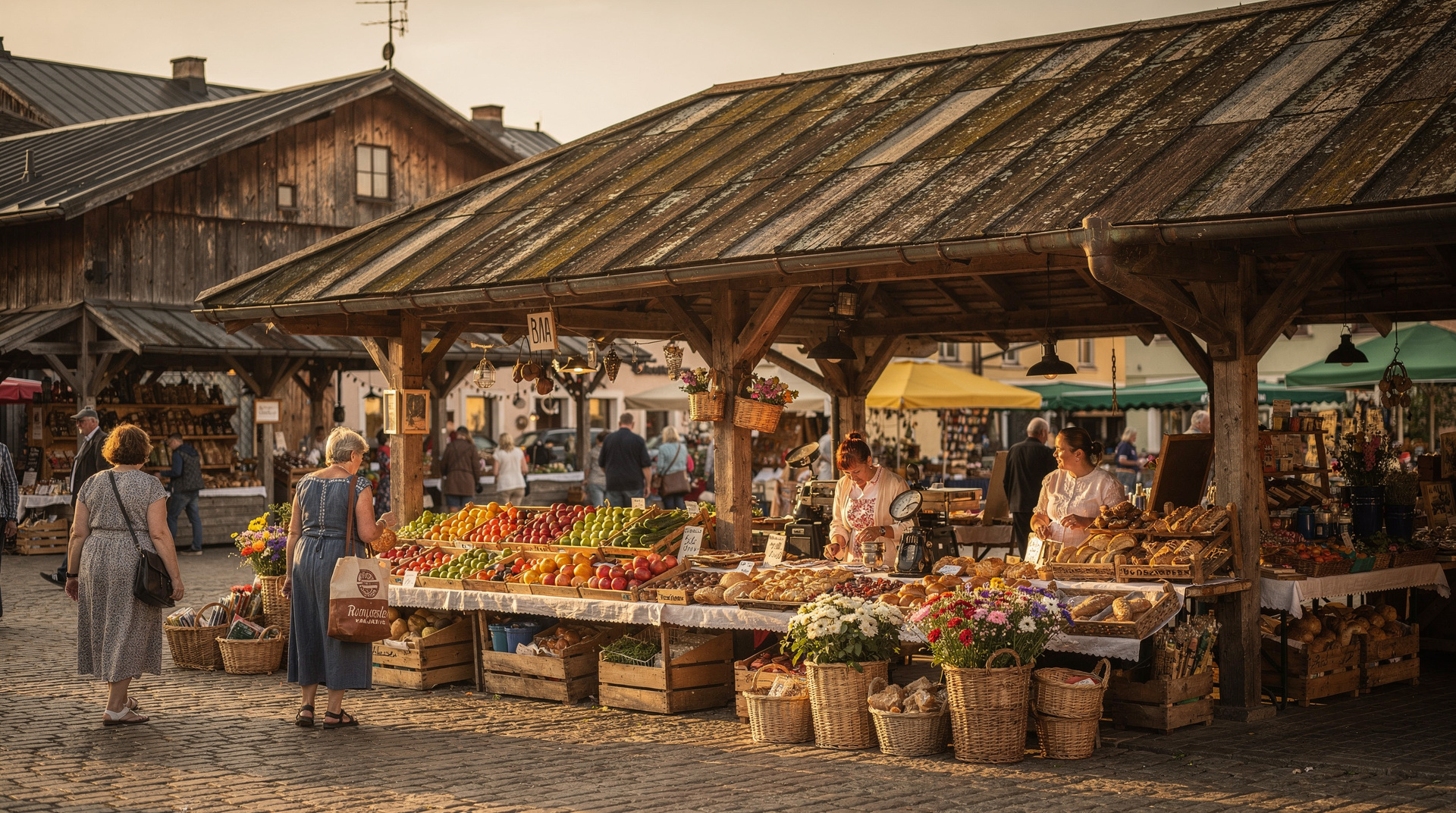
The first half of the experience is a guided food tour of the Central Market: the guide explains the Zeppelin hangar architecture, visits the best vendors in each pavilion, and makes purchases to use in the class. You taste as you go. The second half is the cooking class, in which the market produce becomes the meal.
At €95 (€10 more than the chef masterclass alone), the market tour component represents very good value. This is the best cooking-related experience in Riga for visitors who want both the food education and the hands-on cooking skill.
Best for: Visitors who want the full Latvian food culture experience in a single session; visitors who have less than a full day for food activities; couples or friends who want a memorable shared activity in Riga.
Book the Taste Riga market tour with cooking masterclass (€95, 4 hours)The khinkali and pelmeni class: honest assessment
Price: €55 per person Duration: 2–3 hours Group size: Small group What you cook: Khinkali (Georgian dumplings) and pelmeni (Siberian-Russian dumplings) Rating: 4.8 / 5 (65 reviews) Badges: Meal included
This class is good. The instruction is clear, the dumplings are satisfying to make, and eating what you produce — khinkali and pelmeni — is a good experience. The price is the most accessible of the three options.
But here is the honest context, and it is important:
Khinkali are Georgian, not Latvian. They are the distinctive Georgian soup dumplings — a thick noodle dough gathered at the top around a meat filling, boiled, eaten by holding the topknot. They are a significant part of Georgian cuisine and are genuinely interesting to learn to make. But Georgia is in the South Caucasus, not in the Baltic. There is no historical or cultural connection between Georgian khinkali and Latvian food tradition.
Pelmeni are Siberian-Russian, not Latvian. As discussed in our rye bread, pelmeni and pīrāgi guide, pelmeni became common in Latvia during the Soviet occupation. They are genuinely eaten in Latvia today and are part of the contemporary Latvian food landscape. But they are not pre-war Latvian culinary heritage.
If you want to learn Latvian cooking specifically, this class is not the one to book. It is an Eastern European dumplings class that happens to be offered in Riga. If that is what you want, it is perfectly good; just know what it is.
If you are interested in dumplings from the broader Eastern European and Caucasian tradition, and are fine with that being the focus, this class is excellent value at €55.
Try the khinkali and pelmeni cooking masterclass if Eastern European dumplings is your focus (€55)Honest comparison
| Class | Price | Duration | Latvian? | Best for |
|---|---|---|---|---|
| Latvian food masterclass | €85 | 3–4h | Yes | Latvian cooking |
| Market tour + cooking | €95 | 4h | Yes + market | Full food experience |
| Khinkali + pelmeni | €55 | 2–3h | No (Georgian/Russian) | Dumplings lovers |
Practical tips for cooking classes in Riga
Book in advance. The cooking classes run in small groups and popular dates fill up, particularly July and August. Book at least 2–3 days ahead; 1 week ahead for summer weekend dates.
Wear comfortable clothes you don’t mind getting flour on. Aprons are provided but cooking is a physical activity. Leave the dry-clean-only clothes at the hotel.
Dietary restrictions. Both the Latvian masterclass and the market tour class can accommodate vegetarian participants with advance notice (contact the operator when booking). The traditional Latvian dishes include pork prominently; vegetarian versions of pīrāgi and grey peas exist and can be prepared. Vegan accommodation is more difficult given how central dairy is to Latvian cooking.
For the food context, see our best Latvian foods guide and Central Market visiting guide. For the market tour with cooking class specifically, see our dedicated guide.
Seasonal considerations for cooking classes in Riga
The menu in any of the Riga cooking classes shifts with the season, because Latvian cooking is fundamentally seasonal. Knowing what season you are visiting in helps you anticipate what you will cook.
Spring (April–May): Fresh herb preparations, dairy-forward dishes, rhubarb and early berries in desserts. The pīrāgi filling shifts toward leaner preparations as winter pork stores are depleted. A good time for the lighter side of Latvian cooking.
Summer (June–August): Cold beet soup (aukstā biešu zupa) is the iconic summer dish — bright pink, sharp with kefir, served cold with a hard-boiled egg. Fresh berry desserts. Lighter preparations overall. The market component of any combined market-class experience is at peak abundance.
Autumn (September–October): The richest season for Latvian cooking classes. Mushrooms — dried and fresh — feature in soups and main dishes. Root vegetables, sauerkraut, hearty pork preparations, grey peas with bacon. If you want to cook the core of Latvian traditional food, an autumn class is the ideal.
Winter (November–March): Heavy warming food. Soups, slow-cooked meat, rye bread, dairy. The cooking class in winter focuses on the warming core of Latvian home cooking that developed in response to northern European winters. A good season for those interested in the cultural function of food.
All three cooking class options run year-round; the seasonal variation in the menu is part of the experience rather than a constraint.
What Latvian cooking is and is not
Before booking any cooking class in Riga, it is worth having a clear picture of what Latvian cooking actually involves — because the cuisine has some features that surprise visitors expecting a rich restaurant-style experience.
What Latvian cooking is:
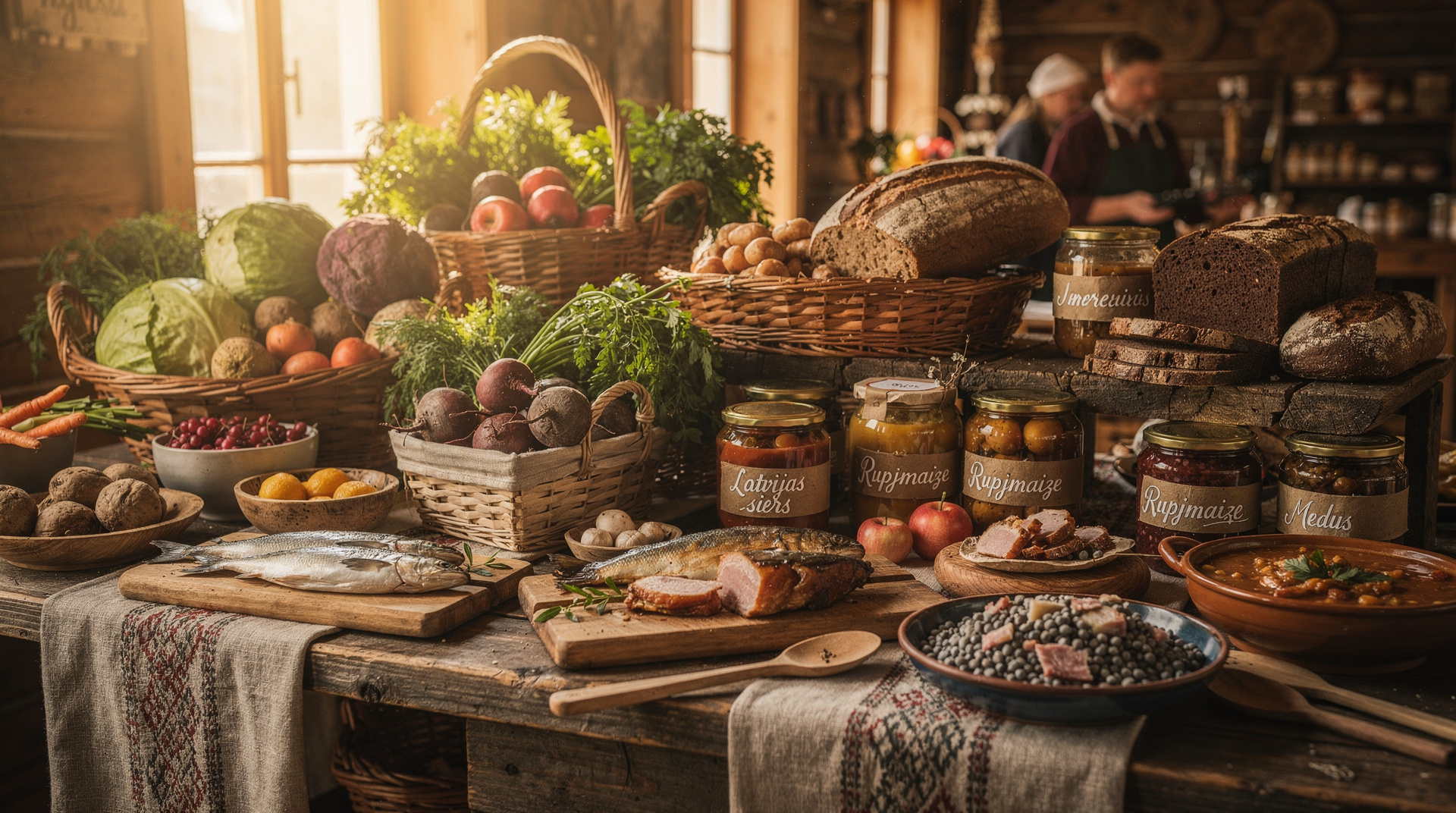
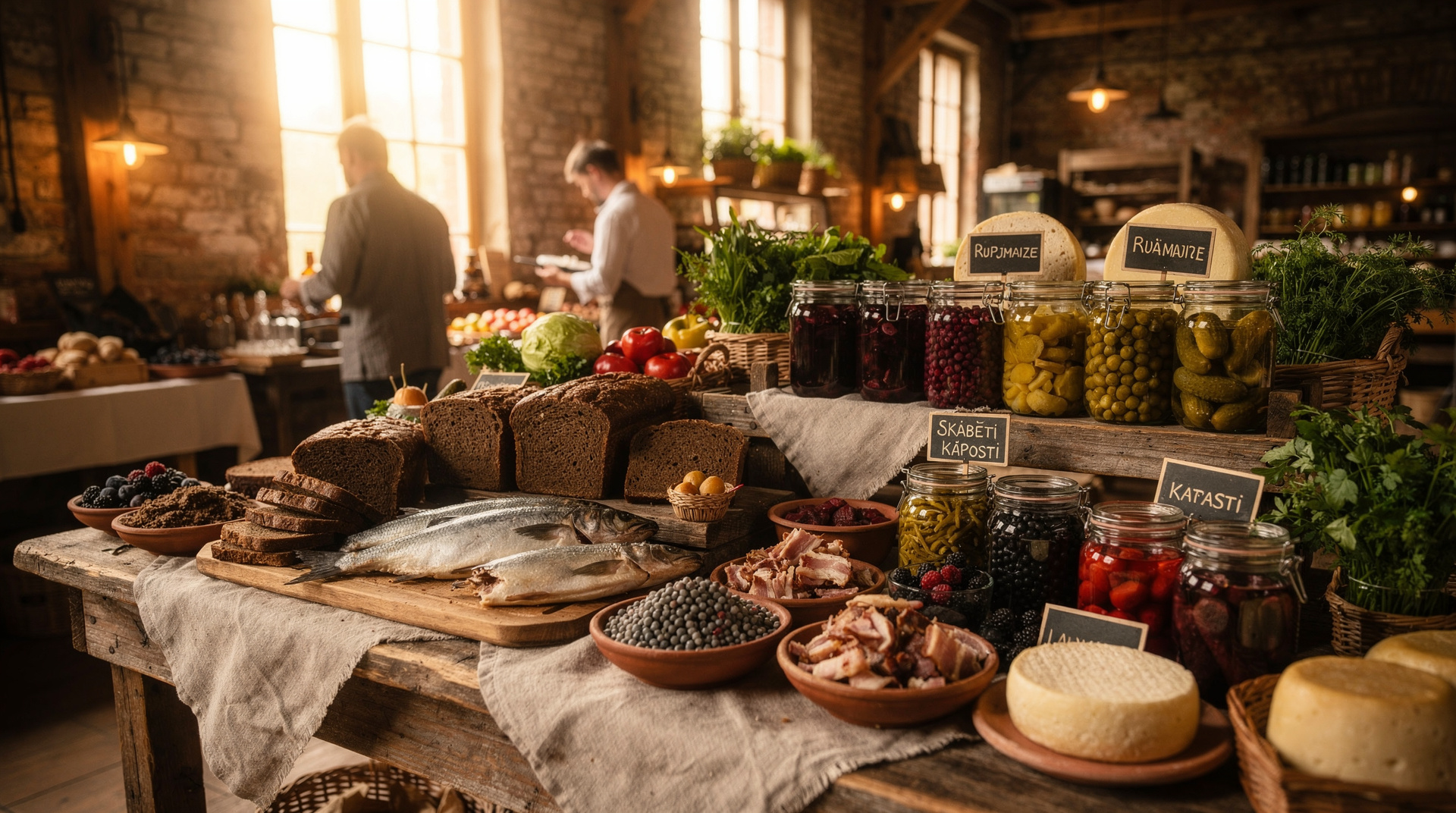
Latvian traditional cooking is Northern European peasant cooking in its character — practical, seasonal, ingredient-led, built around what the landscape produces. Rye and barley bread, dairy products (sour cream, cottage cheese, kefir, buttermilk), pork in all its forms (smoked, fresh, in pastries, in stews), freshwater fish, mushrooms, root vegetables, berries, and preserved foods for the winter. It is honest cooking with genuine depth once you understand its logic.
The flavour profile is often described as earthy, sour (from fermentation — the rye bread sourdough, the sauerkraut, the kefir), and savoury with occasional sweetness from berries and honey. Spicing is light — caraway seeds in the bread, dill on almost everything, occasionally juniper. It is not the spiced, complex cuisine of warmer countries; it is the clean, fermented, smoke-inflected food of the far north.
What Latvian cooking is not:
It is not the heavy, fat-saturated, overly salted experience that some visitors fear from Soviet-era canteen cooking. Home Latvian cooking is generally lighter than its reputation. The best Latvian cooking — in the hands of a guide who respects the tradition — is subtle and interesting.
It is also not Georgian, Russian, or generically Eastern European. The khinkali and pelmeni class is clearly labelled in this guide as a non-Latvian experience; the other two classes focus specifically on the Latvian tradition. If you book the Latvian food masterclass or the market-plus-cooking experience, you will cook genuinely Latvian food.
After the cooking class: where to eat to extend your learning
One of the most useful things a cooking class does is equip you to eat better in Riga for the rest of your trip. You know what pīrāgi should taste like because you made them; you know what properly prepared grey peas should be because you cooked them. This changes how you order in restaurants.
For the best restaurant version of traditional Latvian food, Lido (the largest Latvian self-service chain) is the most reliable for a direct comparison — it is essentially what Latvian home cooking looks like at scale. The Old Town Lido near the canal park is the most accessible.
For a higher-end version of the same tradition, Vincents (Elizabetes iela 19) and The Greenhouse (Elizabetes iela 22) apply fine-dining technique to local ingredients. Reservations required.
For the everyday Latvian café version — dark rye bread, cottage cheese, smoked fish, coffee — the Rocket Bean Roastery on Barona iela 31 and the Gardēdis café nearby do a credible job of integrating the food culture with good coffee. See our café guide by neighbourhood for a full breakdown.
The Central Market is the best post-class destination for buying ingredients to take home — the same vendors you visited with the guide, the same products, but now you know what to buy and why.
Frequently asked questions about Riga cooking classes
How far in advance should I book a cooking class?
At least 2–3 days ahead for weekday classes. At least 1 week ahead for summer weekend slots. The Taste Riga market-plus-cooking class fills fastest; the standalone masterclasses have slightly more availability. Late booking is possible but risky in July and August.
Are cooking classes suitable for visitors who don’t cook at home?
Yes. The classes are instruction-led, not ability-led. The guide demonstrates each technique before participants attempt it. No prior cooking skill is assumed. People who have never made pastry before regularly complete the pīrāgi with good results. The level of instruction is pitched at beginners while remaining interesting for more experienced cooks.
Can I take the recipe home?
Yes. All the cooking class operators provide a printed recipe card for the dishes covered. Some provide a small package of Latvian ingredients (dried mushrooms, caraway seeds, rye flour) alongside the recipe. This is one of the more useful souvenirs from Riga.
Is the food you cook in the class actually good?
Generally, yes — with the caveat that first attempts at unfamiliar techniques are variable. Pīrāgi made by a first-timer will be slightly less perfect than the guide’s demonstration version, but they are still good. The grey peas and soups are harder to get wrong and reliably satisfying. The cold beet soup in summer is almost always excellent regardless of experience level because the technique is simple and the market ingredients are excellent.
Are any cooking classes gluten-free?
Difficult, given that Latvian cooking is built substantially around rye bread. Some elements of the class can be made gluten-free with advance notice and ingredient substitution, but the core Latvian cooking curriculum involves wheat and rye throughout. Contact the operator before booking if gluten is a medical concern rather than a preference.
How a class fits a wider food-focused visit
A cooking class works best as one part of a broader Riga food itinerary rather than an isolated activity. Pair it with the Riga Central Market visiting guide if you want to explore the market independently before or after a class, and check best Latvian foods to try in Riga for what to look for on restaurant menus once you understand the ingredients.
For deeper context on the specific dishes covered in most classes, Latvian rye bread, pelmeni and pīrāgi essentials explains exactly which foods are genuinely Latvian and which arrived during the Soviet period — the same distinction that separates the chef masterclass from the khinkali/pelmeni class in this guide.
Top experiences
Bookable activities with verified prices and instant confirmation on GetYourGuide.