Vilnius from Riga: day-trip or overnight guide (4 h bus, €15–25)
Complete guide to visiting Vilnius from Riga. Bus options, costs, what to see in a day, where to eat and stay, plus honest advice on day-trip vs overnight.
From Riga to Vilnius: top private tour with sightseeing stops
Duration: 8-9 hours
- Private group
- Door to door
Quick facts
- Distance
- 310 km by road (similar to Tallinn)
- Bus time
- ~4 hours (Lux Express or Ecolines, via Šiauliai)
- Bus cost
- €15–25 one way booked ahead
- Train
- Indirect — change at Šiauliai; slower and less convenient than bus
- Currency in Lithuania
- EUR — same as Latvia, no exchange needed
- Language
- Lithuanian; English widely spoken in Vilnius centre
Vilnius: the Baroque capital at the end of the Baltic bus route
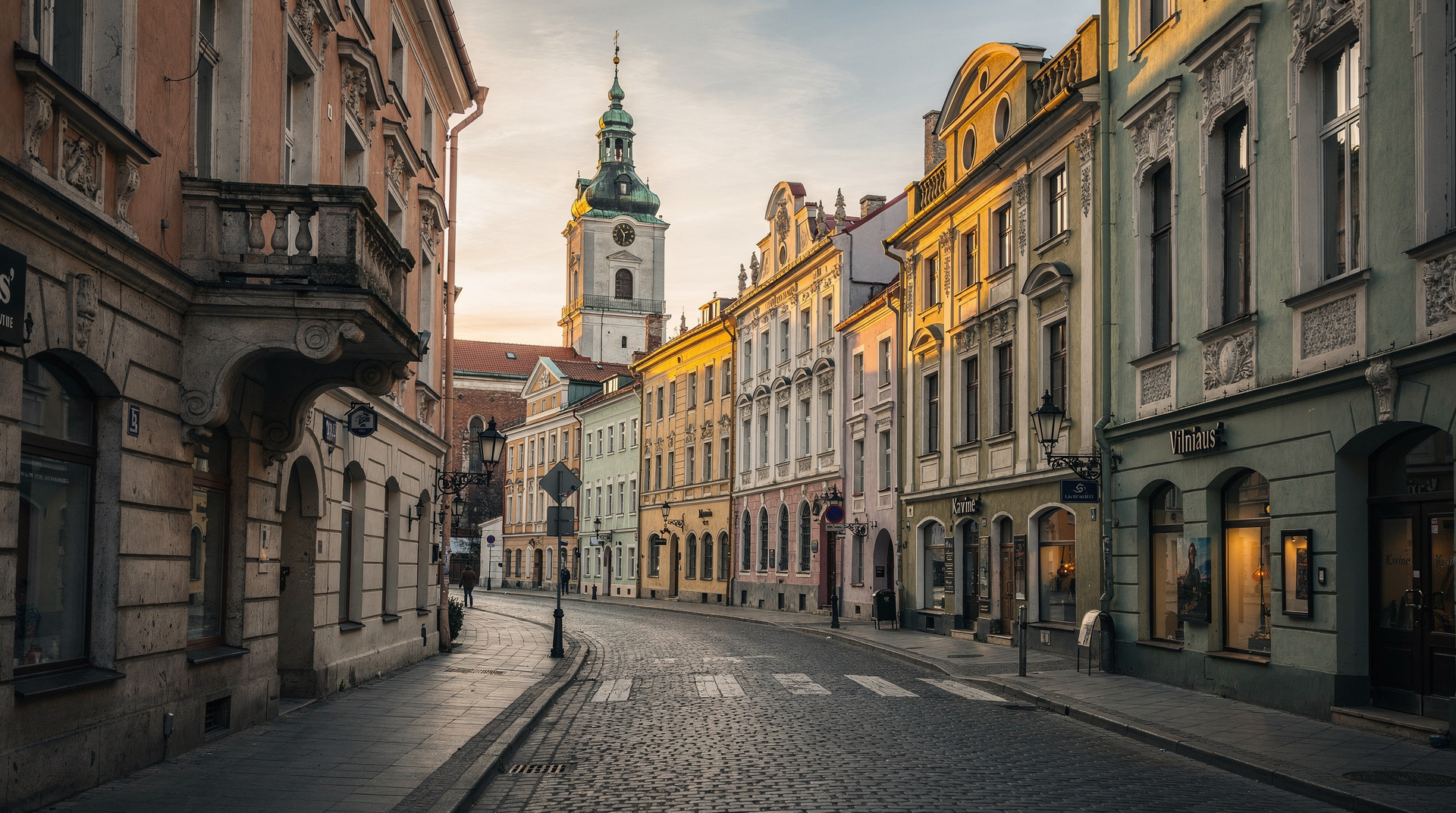
Of the three Baltic capitals, Vilnius is the most architecturally dramatic and the least expected. Where Riga is defined by Art Nouveau and medieval brick, and Tallinn by compact medieval towers, Vilnius is overwhelmingly Baroque — a consequence of its history as a major centre of the Polish-Lithuanian Commonwealth, when Italian and local architects covered the city in ornate facades, gilded altarpieces and church towers. The Old Town is UNESCO-listed and contains more than 30 Catholic churches within walking distance of each other.
The journey from Riga takes roughly 4 hours by Lux Express (same journey time as Tallinn, but in the opposite direction — south instead of north). The route passes through Lithuania’s second city Šiauliai, near the Hill of Crosses, before continuing south to Vilnius. Prices are broadly the same as the Tallinn route: €15–25 booked ahead.
Vilnius is large enough and varied enough that a day-trip feels rushed. The Old Town alone can fill a full day. The bohemian republic of Užupis, the Gediminas Castle viewpoint, the Gates of Dawn and the baroque Old Town churches are all essential — and that is without touching Paneriai (the Holocaust site), Kernavė (the medieval capital) or the excellent National Museum of Lithuania. For most visitors, an overnight in Vilnius is the honest recommendation.
| Where | Vilnius Old Town, 310 km south of Riga |
| Cost | around €15–25 one way by bus, booked ahead |
| Time needed | day-trip possible but rushed; 1–2 nights recommended |
| Getting there | Lux Express or Ecolines bus, ~4 hours via Šiauliai |
| Best time | May–September; spring for blossom; December for markets |
For the wider Baltic capitals loop, see the Baltic capitals 7-day itinerary and the guide to which order to visit them in.
What to see in Vilnius on a day-trip or longer stay
The Old Town (Senamiestis): where to start
Vilnius Old Town is large — one of the biggest surviving medieval old towns in Central Europe — so a day-trip visitor needs to prioritise. The essential circuit covers:
Cathedral Square (Katedros aikštė): Vilnius Cathedral (neo-classical, 18th century) and its bell tower anchor the northern edge of the Old Town. The royal crypts beneath the cathedral contain the remains of Lithuanian Grand Dukes.
Gediminas Castle and Museum Hill (Gedimino pilies bokštas): a short funicular or 15-minute walk up to the medieval tower that overlooks the city. The views over the red rooftops and the confluence of the Neris and Vilnelė rivers are the defining Vilnius panorama. Museum inside costs €5.
Pilies Street (Pilies gatvė): the main pedestrian artery of the Old Town, running south from Cathedral Square. Lined with cafés, amber shops and ice cream vendors — touristy but visually satisfying.
The baroque churches: St Anne’s Church (red-brick Gothic-Baroque hybrid, often described as Napoleon’s favourite building), Bernardine Church adjacent to it, and St Peter and Paul Church (the most extravagantly decorated baroque interior in the Baltics, with over 2,000 white stucco figures). St Peter and Paul is 15 minutes’ walk from the main pedestrian zone — it is worth the detour.
The Gates of Dawn (Aušros vartai): at the southern end of the Old Town, the only remaining city gate contains the venerated Chapel of the Blessed Virgin Mary — an important Catholic pilgrimage site and a significant piece of Lithuanian devotional history.
Užupis: the self-declared republic
Užupis (behind the Old Town across the Vilnelė river) declared itself an independent republic in 1997 — a conceptual artistic gesture that has somehow endured. It has its own president, constitution (displayed in multiple languages on plaques along Paupio gatvė) and honorary ambassadors. In practice it is a bohemian neighbourhood of galleries, studios and cafés. The April 1st “independence day” parade draws artists and travellers from across Europe. Worth a 1-hour wander on any visit.
Kernavė: Lithuania’s medieval capital
Kernavė (40 km from Vilnius) is a UNESCO World Heritage Site — a series of earthwork mounds marking the site of Lithuania’s medieval capital, with a small archaeological museum below. On a day-trip from Riga, combining Vilnius and Kernavė is tight but possible with a car. The guided transfer option from Riga to Vilnius via Kernavė is a natural fit.
Vilnius vs Tallinn: which to add first
If you can only add one Baltic capital to your Riga trip, the choice comes down to time available. Tallinn suits a genuine day-trip — smaller Old Town, easier logistics, back in Riga by evening. Vilnius rewards an overnight far more: its Old Town is larger, its churches take longer to appreciate, and Užupis and Kernavė add real value that a single rushed day cannot capture. See the Riga vs Vilnius comparison guide for how the two capitals themselves differ, separate from the logistics question.
How to get from Riga to Vilnius
By bus (the standard option)
Lux Express operates Riga–Vilnius multiple times daily. The service runs via Panevėžys and occasionally Šiauliai. Journey time: approximately 4 hours. Cost: €15–25 one way booked ahead, €35–45 last-minute or peak dates. Departs from Riga International Bus Terminal.
Ecolines serves the same route at similar pricing. Check both for the best available times.
Note on the Šiauliai routing: buses to Vilnius do not always stop in Šiauliai — check the timetable if you want to visit the Hill of Crosses en route (see the separate Hill of Crosses from Riga page). Most Vilnius services stop in Šiauliai or pass nearby, but a dedicated Hill of Crosses day usually requires a separate itinerary.
By train (not recommended)
A train route from Riga to Vilnius exists but requires a change at Šiauliai and takes 5–6 hours. It is slower, less comfortable and less frequent than the bus. Use the bus.
By private transfer with sightseeing
A private transfer from Riga to Vilnius with sightseeing stops is the most flexible option for those with a car budget. Standard stops include Rundāle Palace (in Latvia), the Hill of Crosses (Lithuania), and in some tours, Kernavė (outside Vilnius). Journey times are 8–11 hours depending on stops.
From Riga to Vilnius: top private tour with sightseeing stops — a private 8–9 hour tour with a driver-guide, covering the key stops between the two capitals. Door-to-door service. The best option for those who want the full Riga–Vilnius corridor experience without bus transfers.
From Riga: private transfer to Vilnius with sightseeing — similar to the above but with a stronger emphasis on transport and lighter commentary. Good for those who have been to the region before and want to make specific stops.
Riga–Vilnius transfer with Rundāle Palace, Hill of Crosses and Kernavė — the comprehensive full-corridor tour (11 hours) that combines three UNESCO-level sites with the transfer. Only practical as a one-way Riga to Vilnius trip (you do not return to Riga that day).
Where to eat in Vilnius
Etno Dvaras (Pilies 16): Old Town restaurant focused on traditional Lithuanian cuisine. Try the cepelinai (potato dumplings stuffed with meat, served with sour cream) — the national dish — and the cold beet soup (šaltibarščiai) in summer. Mains €10–18. Reliably good and no worse than anywhere else at this price point.
Forto Dvaras (near Cathedral Square): similar profile to Etno Dvaras, often slightly less crowded. Both are tourist-oriented but honest — Lithuanian food is genuinely worth trying.
Lokys (Stiklių 8): medieval cellar restaurant — atmospheric, slightly theatrical, the game menu (venison, wild boar, duck) is the focus. Mains €18–30. The most memorable dinner option on a limited Old Town budget.
Šaltanosio Pie Shop (Stiklių 7): tiny spot for Lithuanian pastries and home-style pies. Lunch under €8. Popular with locals working near the Old Town.
What to avoid: the café directly beneath Gediminas Castle tower is overpriced and mediocre — the views are free, no need to pay for bad coffee. The Old Town has dozens of tourist-facing restaurants on Pilies Street that charge Tallinn-equivalent prices for average quality. Walk one block off the main drag for better value.
Where to stay in Vilnius
If you decide to stay overnight (the recommended option for a proper Vilnius visit):
Boutique hotels in Senamiestis (Old Town): the most characterful options. Shakespeare Hotel (Bernardinų 8) is excellent — individually decorated rooms, excellent staff, from €110/night. Artagonist Hotel is slightly more design-forward, from €95/night.
Stikliai Hotel: the most prestigious address in the Vilnius Old Town. Baroque building, 43 rooms, outstanding restaurant. From €180/night.
Neringa Hotel (near Cathedral Square, Soviet-era building): a quirky option for those who appreciate Cold War aesthetics — the interior has been preserved rather than renovated. From €60/night.
Hostels: several good options in the Old Town from €20–25/person. Hostelgate Old Town is reliably reviewed.
Vilnius hotels are generally 15–20% cheaper than Tallinn equivalents and broadly comparable to Riga’s mid-range.
Booking early matters less in Vilnius than in Riga or Tallinn during peak weeks — the city has a larger hotel stock relative to its tourist numbers, so last-minute availability is usually reasonable outside major events. That said, the well-known boutique properties in Senamiestis do sell out on summer weekends, so book at least a few weeks ahead if you have your heart set on a specific address.
The Baltic capitals loop: how Vilnius fits the itinerary
Vilnius is the natural southern anchor of the Baltic capitals circuit. The classic structure runs Riga → Tallinn (north, 4h by bus) → Riga → Vilnius (south, 4h by bus), though many visitors do it as a one-way loop: Riga → Tallinn → ferry to Helsinki (2.5 hours), or Riga → Vilnius → Warsaw by bus or train.
For a 7-day Baltic trip, the most efficient itinerary is:
Day 1–2: Riga (Old Town, Art Nouveau, day-trip Jūrmala or Sigulda) Day 3: Bus to Tallinn (08:00), arrive midday, Old Town afternoon and evening Day 4: Tallinn — Kadriorg, Telliskivi, full day Day 5: Bus back to Riga (or continue to Helsinki by ferry). Alternatively: bus to Vilnius Day 6–7: Vilnius — Old Town, Užupis, Kernavė excursion
For a 10-day trip, the Hill of Crosses and Rundāle Palace fit naturally as a day-trip from either Riga or as stops on the Riga–Vilnius route — see the Rundāle and Bauska day-trip guide and the Hill of Crosses day-trip guide for the Latvia-side legs of that route.
The Riga–Vilnius–Riga round trip by bus (€30–50 total for both legs booked ahead) is economical. The Riga–Vilnius–Warsaw combination (Vilnius to Warsaw by bus, ~9 hours, €20–35) is popular with visitors entering the Baltic region from Poland or continuing south.
| Factor | Riga | Vilnius |
|---|---|---|
| Signature architecture | Art Nouveau, medieval brick | Baroque churches, 30+ in the Old Town |
| Day-trip feasibility | — | Rushed; overnight recommended |
| Restaurant meal (mid-range) | around €15 | around €12–18 |
| Hotel (mid-range, Old Town) | comparable | around 15–20% cheaper than Tallinn |
| Best for | Art Nouveau, food, nature day-trips | Baroque architecture, Užupis, church interiors |
Baroque Vilnius in depth: the churches worth seeking out
Vilnius has over 30 Catholic churches in its old town — more per square kilometre than any other city in the Baltics. Not all are worth a detour, but several are essential:
St Peter and Paul Church (Šv. Petro ir Pauliaus bažnyčia, Antakalnis 1): arguably the most spectacular Baroque interior in the entire Baltic region. The nave is covered floor-to-ceiling in white stucco figures — over 2,000 of them, in various scenes from the life of saints and allegorical representations. Built 1668–1701. Open to visitors; entry free but donation expected. A 15-minute walk from the main Old Town via Kosciuškos gatvė.
St Anne’s Church (Šv. Onos bažnyčia, Maironio 8): a late Gothic-Baroque hybrid in red-brick, built around 1500. Napoleon reportedly said he wanted to carry it home to Paris in the palm of his hand. The exterior is the main attraction — a complex decorative facade of 33 different types of brick. Next door, the Bernardine Church (16th century) is larger and plainer but with good frescoes.
Vilnius University Church of St Johns (inside Vilnius University courtyard): the university was founded in 1579 by Jesuits and the church complex forms its heart. The courtyard itself is one of the most beautiful architectural spaces in Vilnius. The church has been through various uses over the centuries (library, stores) and was only returned to religious use in 1991.
Church of the Holy Spirit (Šv. Dvasios bažnyčia): the most important Orthodox church in Vilnius, built in the 17th century. The interior contains the relics of three Lithuanian martyrs (SS Antanas, Jonas and Eustachijus) — a significant pilgrimage destination for Orthodox Christians.
Five hours is genuinely not enough for Vilnius’s church architecture. Visitors who care about Baroque interiors should plan at minimum an overnight.
For a broader sense of how a 7-day Baltic trip fits everything together — Riga’s own Art Nouveau and Old Town alongside Tallinn and Vilnius — the 7-day Baltic capitals order guide sets out a realistic pace rather than an exhausting sprint between three cities.
Honest tips for Riga–Vilnius
Book the bus early for summer. Lux Express Riga–Vilnius fills up in July and August, though slightly less dramatically than Riga–Tallinn. Book at least a week ahead for summer weekend travel.
The Hill of Crosses is near the bus route but not on it. If you want to visit the Hill of Crosses (Kryžių kalnas, 12 km from Šiauliai), you need a dedicated day-trip structure — not a simple stop on the Vilnius bus. See the Hill of Crosses page for how to organise this.
Vilnius is not a day-trip city. The Old Town is large, the churches require time, and the most interesting experiences (Užupis, St Peter and Paul, Kernavė) take the trip well beyond 8 hours. If you are choosing between Vilnius and Tallinn for a day-trip, Tallinn’s Old Town is smaller and easier to cover in a day. Vilnius deserves an overnight.
Lithuanian amber is everywhere in Vilnius — and very variable in quality. The genuine Baltic amber from the region has a warm honey colour. Heavily dark or very pale pieces may be simulated. Buy from established shops with certificates if you care about authenticity.
Cepelinai will fill you completely. The national dish (potato zeppelin dumplings, typically golf-ball or tennis-ball sized) is deeply filling. Order one as a starter rather than two as a main if you plan to continue sightseeing afterwards.
Pack comfortable shoes for cobbles and hills. Vilnius Old Town’s terrain is hillier than Riga’s or Tallinn’s — the walk up to Gediminas Castle and the streets around Užupis involve genuine gradients, not just flat pedestrian lanes.
Frequently asked questions about Vilnius from Riga
How long is the bus from Riga to Vilnius?
Approximately 4 hours on Lux Express or Ecolines. Check the timetable — some services stop more frequently and may take 4.5 hours.
Is there a direct train from Riga to Vilnius?
Not directly — a change at Šiauliai (Lithuania) is required. The total journey is 5–6 hours. The bus is faster, more comfortable and better value. Use the bus.
How much does the bus from Riga to Vilnius cost?
€15–25 one way booked ahead. Last-minute prices can reach €35–45. There is no return-ticket discount — two one-way tickets are standard.
Is Vilnius better visited as a day-trip or overnight?
Overnight is better for most visitors. The Old Town is large, the baroque churches require time, and the most interesting neighbourhood (Užupis) plus outlying sites (Kernavė, Paneriai) push the trip comfortably into two days. The day-trip is possible if you are disciplined about priorities, but it feels compressed.
What is the most famous dish in Vilnius?
Cepelinai — potato dumplings stuffed with minced meat (or mushrooms in the vegetarian version), boiled and served with sour cream and crispy bacon. Every traditional restaurant in Vilnius serves them. They are heavy, filling and worth trying at least once.
How does Vilnius compare to Riga?
Vilnius has more Baroque architecture, more Catholic churches, a denser medieval core and (many visitors argue) a slightly softer urban atmosphere. Riga has better Art Nouveau, a livelier food and bar scene, lower prices, and easier transport connections to nature (Sigulda, Gauja, Jūrmala). Both cities reward multiple days. For a first Baltics trip, Riga is the better base; Vilnius is a strong reason to extend the trip to 7 days.
Can I visit both Tallinn and Vilnius on the same trip from Riga?
Yes — the classic “Baltic capitals loop” is Riga (2 nights) → Tallinn (2 nights, Riga–Tallinn by bus) → Vilnius (2 nights, Tallinn–Vilnius by bus — 8 hours — or fly). The loop ends in Vilnius, from which you can fly back to your origin. This is 7 days minimum; 10 days is more comfortable. See the Baltic capitals 7-day itinerary for the day-by-day version.
Can I combine Vilnius with Rundāle Palace or the Hill of Crosses?
Yes, and it’s a popular way to do the route — a private transfer with sightseeing stops can include Rundāle Palace and the Hill of Crosses en route to Vilnius, turning the transfer itself into a full day of sightseeing rather than just travel time. The comprehensive full-corridor tours combining all three UNESCO-level sites only work as a one-way Riga to Vilnius trip.
Is Vilnius or Tallinn the better first addition to a Riga trip?
For most first-time Baltics visitors with limited time, Tallinn is the easier addition — a genuine day-trip with a smaller, denser Old Town. Vilnius is the stronger choice if you have at least two extra nights and care more about Baroque architecture and church interiors than compact medieval streets. See the Riga vs Vilnius guide for a fuller comparison.
Top experiences
Bookable activities with verified prices and instant confirmation on GetYourGuide.