Swedish Gate and medieval walls of Riga: what survives and where
Riga: guided Old Town walking tour
Duration: 2 hours
- Free cancellation
- Small group
- English guide
Where is the Swedish Gate in Riga and can you walk through it?
The Swedish Gate (Zviedru vārti) is on Torņa iela in Old Town Riga, built into the wall of a residential building in 1698. Yes, you can walk through it — it is a functioning archway in a passageway that is always open. It is the only surviving gateway in Riga's medieval city walls. Free to see.
What survives of medieval Riga’s defences
Medieval Riga was a fortified Hanseatic city — surrounded by walls, towers, and gates that protected one of the most commercially important ports in Northern Europe. At the height of its fortification in the 16th–17th centuries, the city walls included over 25 towers, multiple gates, and a defensive moat (now the city canal).
Almost none of it survives intact. The expanding city gradually demolished its own walls as growth made the old fortifications obsolete and the building material was reused. What exists today are fragments: the Swedish Gate, a section of tower wall on Torņa iela, the Powder Tower on Smilšu iela, and sections incorporated into later buildings.
For visitors, these fragments are genuine historic material — not reconstructions. Walking past the Swedish Gate means passing through a real 17th-century archway in its original position, built into a building that has stood continuously for over 300 years.
| Where | Torņa iela, northern Old Town, near Riga Castle |
| Cost | Free |
| Time needed | 10–15 minutes for the gate; 45 minutes for the full wall walk |
| Getting there | 8–10 min walk from Town Hall Square |
| Best time | Early morning for empty streets; dusk for atmospheric lighting |
The Swedish Gate: details
The Swedish Gate (Zviedru vārti) is located on Torņa iela in the northern section of Old Town Riga, not far from Riga Castle. Built in 1698 during the Swedish imperial period of Latvian history, the gate was created as a passage through the city wall — not a grand ceremonial entrance but a functional working gate, built into the ground floor of a residential building as a cost-efficient use of the wall.
The architecture: the gate is a pointed arch opening (Gothic in profile, though built in the Baroque period — reflecting conservative construction habits for defensive elements) running under the residential floors above. The building containing the gate shows a mix of 17th-century construction and later modifications. The gate passage itself is approximately 4 metres deep and 3 metres wide.
Why it survived: most of Riga’s other medieval gates were demolished as the city expanded beyond its walls in the 18th and 19th centuries. The Swedish Gate survived partly because it was built into a living building rather than as a free-standing structure — demolishing the gate would have meant demolishing the entire house above it.
The legend of the hangman: Old Town guides sometimes tell a story that the gate arch was used by Riga’s hangman to enter and exit the city so that his presence would not defile the main gates used by respectable citizens. This story appears in various forms and its historical basis is uncertain.
Jacob’s Barracks and the wall section
Adjacent to the Swedish Gate on Torņa iela are Jacob’s Barracks (Jēkaba kazarmas), a long two-storey building running parallel to the old wall line. Built around 1685–1697 (also during the Swedish period), the barracks were originally a military accommodation block for the Riga garrison.
The yellow-plastered facade of Jacob’s Barracks today houses shops, restaurants, and a hotel at street level. The building’s historical character is visible in its length, its regular window rhythm, and the way it follows the curve of the old wall line.
The wall section: between the Swedish Gate and the beginning of Torņa iela park, a short section of the original city wall is visible — sandstone masonry, similar to the tower material. This is genuine medieval material, not a reproduction.
The Powder Tower: the most complete survivor
While the Swedish Gate is the most famous surviving element, the Powder Tower (Pulvertornis) at the east end of Smilšu iela is the most structurally complete surviving tower of the medieval fortifications.
The tower is large (about 25 metres in diameter at the base), round, and built of reddish-brown brick and sandstone — typical of 14th-century Livonian military architecture. It has been incorporated into the Latvian War Museum (Latvijas Kara muzejs), which occupies the building around and adjacent to it.
The War Museum: a worthwhile visit for history enthusiasts. It covers Latvian military history from the medieval period through World War II and covers the independence periods of 1918–1940 and post-1991. The tower’s interior shows original medieval construction. Admission: free.
Walking the old wall line
The approximate line of the original city walls can be walked in about 45 minutes:
- Start at the Powder Tower (Smilšu iela, east end of Old Town): the most complete tower
- Walk north on Torņa iela: the street name literally means “Tower Street” — a direct indication of its relationship to the old wall
- Swedish Gate: the surviving gate
- Jacob’s Barracks: the wall-aligned military building
- Continue north: the wall line turns west toward the castle area
- West bank: the Daugava River served as the natural western defence — no masonry wall was needed along the riverfront
The south and southeast sections of the wall were demolished in the 19th century as Riga’s main commercial expansion moved outward. The city canal marks the approximate line of the old moat on the east side.
For context on the medieval fortifications within Riga’s broader urban history, the guided Old Town walking tour is the most efficient way to understand what you are looking at — the fragments only make sense when a guide explains what the complete wall system would have looked like.
Torņa iela at night
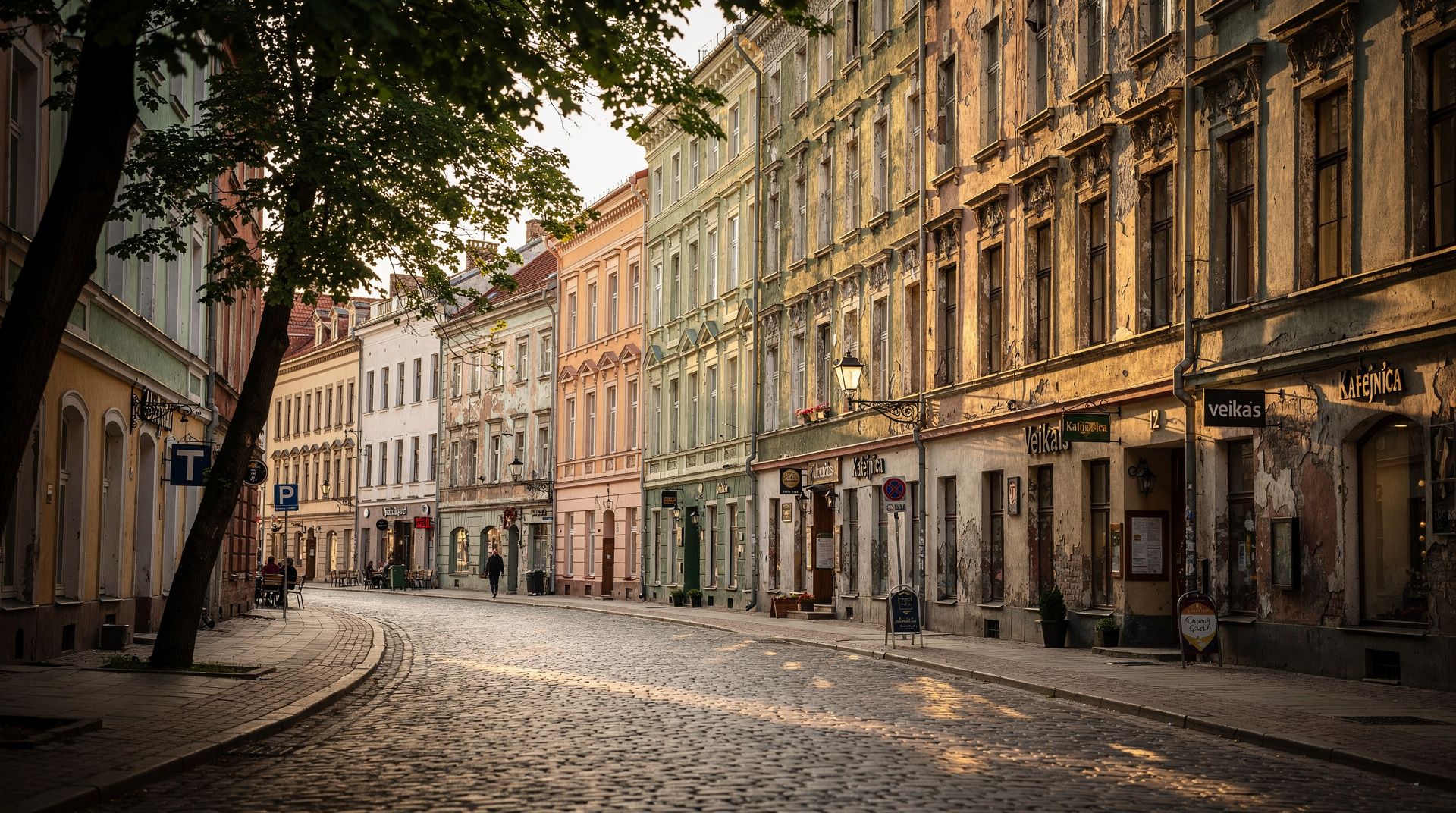
Torņa iela is one of Old Town’s most atmospheric streets after dark. The combination of the Swedish Gate lit by its stone-filtered archway light, the cobblestones underfoot, Jacob’s Barracks’ yellow-painted wall receding into darkness, and the relative quiet of a side street away from the main tourist flow — it is genuinely beautiful.
The street is safe and well-lit enough for evening walking. Photographers often seek it out at dusk when the warm artificial light contrasts with the blue-grey sky.
Practical visiting information
Swedish Gate location: Torņa iela, between the northern edge of Old Town and Riga Castle. From Town Hall Square: walk north via Meistaru iela and Jaunā iela, approximately 600 metres (8–10 minutes).
Opening hours: the gate passage is always open — it is a public thoroughfare, not a ticketed attraction.
Admission: free. Walking through the gate is free. The Latvian War Museum (Powder Tower) is free.
Best time: early morning for empty streets and good light on the cobblestones. Evening for atmospheric lighting.
Combining the Swedish Gate with the rest of Old Town
Torņa iela sits close to Riga Castle, the presidential residence, so the two combine naturally into one short walk. Heading south, the House of the Blackheads visiting guide and St. Peter’s Church and the viewing platform guide cover Town Hall Square, a 10-minute walk away.
For the full medieval circuit including the Three Brothers houses, see our self-guided Old Town walking route, and the Riga history museums overview has more on the Latvian War Museum inside the Powder Tower.
Frequently asked questions about the Swedish Gate and city walls
How long did it take to build Riga’s original city walls?
The medieval fortification system developed over several centuries, from the initial walls of the 13th century through the expanded system completed in the 16th–17th centuries. It was never a single project but an incremental development responding to the city’s growth and changing military technology.
Why were most of the walls demolished?
Several reasons: the walls constrained the city’s physical expansion as Riga grew beyond its medieval limits in the 18th–19th centuries; the fortifications had become militarily obsolete by the 18th century (cannon made medieval walls inadequate for modern siege warfare); and the stone and brick of the walls were valuable building material for new construction. Most European cities demolished their medieval walls for the same reasons.
Is the Swedish Gate related to the Swedish Gate in Stockholm or Tallinn?
No direct relationship. The name simply reflects the era of construction (during Swedish rule). Tallinn has its own well-preserved medieval gate towers, but these are different structures from different periods.
Can you climb the Powder Tower?
The Latvian War Museum within the Powder Tower allows access to certain floor levels with the museum exhibition. The interior of the medieval tower shell is visible. Full tower-top access may be restricted — check with the museum.
What period were the walls demolished?
Most of the demolition occurred in two phases: the 18th century (when Swedish military engineering was replaced by modern earthwork fortifications that extended beyond the old wall line) and the 19th century (when urban expansion drove systematic demolition of what remained). The Canal Park on the eastern edge of Old Town was created in the 1860s–1880s on the site of the old moat and fortification zone.
Top experiences
Bookable activities with verified prices and instant confirmation on GetYourGuide.