St. Peter's Church Riga and the viewing platform: complete guide
Panorama Riga observation deck ticket (Academy of Sciences)
Duration: 1 hour
- Mobile ticket
- Free cancellation
Is the St. Peter's Church viewing platform worth it?
Yes. The observation deck at 72 metres provides the best panoramic view of Riga's Old Town rooftops, the Daugava River, and on a clear day, the Art Nouveau skyline. The lift takes 60 seconds. Allow 20–30 minutes at the top. Buy your ticket at the door or online (check the current price on the church's official site).
St. Peter’s Church: the defining landmark of Riga’s skyline
Walk anywhere in Old Town and look up: the slender spire of St. Peter’s Church (Svētā Pētera baznīca) defines the medieval skyline. It has dominated the Riga roofline since the 13th century — though as you will learn, the specific spire you see today has a more recent and dramatic history.
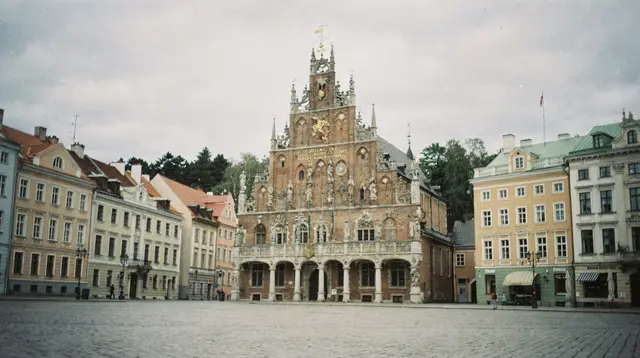
The church is located directly on Town Hall Square (Rātslaukums), adjacent to the House of the Blackheads. It is one of Riga’s three great medieval churches (alongside the Cathedral and St. John’s Church) and the one most visitors spend time with, primarily because of the viewing tower.
| Where | Town Hall Square (Rātslaukums), Old Town |
| Cost | Check the current price on the church’s official site; entering the nave is free to enter the nave |
| Time needed | 20–30 minutes at the top; 45 minutes with the church interior |
| Getting there | Walkable from anywhere in Old Town |
| Best time | Morning for Old Town light; golden hour before sunset in summer |
The history of the spire: a story of repeated destruction
St. Peter’s Church was first mentioned in 1209, making it one of Riga’s oldest institutions. The brick Gothic nave visible today was largely built in the 14th and 15th centuries. The tower is a more complicated story.
The original wooden spire was rebuilt multiple times over the centuries — it burned in 1677 and was rebuilt in 1690 in a Baroque design that became the model for the current form. That 1690 spire stood until 1941, when German aircraft fire started a fire that burned the wooden structure to the ground. The bells and rooster weathervane (Riga’s symbol, present on the spire since 1666) fell crashing to the ground.
During the Soviet period, the church stood without its spire for decades. In the 1970s, a reconstruction project replaced the wooden spire with a steel and aluminium replica, working from historical plans and photographs. The current spire was completed in 1973. It is not the original — but it faithfully reproduces the 1690 design that made St. Peter’s famous.
The rooster weathervane: the original 1666 rooster was replaced after each rebuilding, and several different roosters have crowned the spire over the centuries. One of the historic roosters is on display inside the church.
The viewing platform: the best view in Riga
The observation deck at 72 metres is the most popular thing to do at St. Peter’s, and for good reason — it provides the clearest overview of Riga’s historic core from the most centralised vantage point.
What you see: immediately below, the Town Hall Square and the distinctive triangular footprint of the House of the Blackheads. Moving outward, the Cathedral dome and the surrounding medieval building fabric. The Daugava River to the west, with Ķīpsala island and its wooden architecture visible. Looking east, the Central Market’s enormous green roofs — former zeppelin hangars, remarkably preserved. Looking northeast, the Academy of Sciences’ Socialist Baroque tower (the “Stalin’s Birthday Cake”). On clear days, the Art Nouveau boulevard rooflines and, toward the horizon, the Gauja valley hills.
The observation deck is enclosed by a metal railing and is safe and comfortable. Photography is excellent — bring a wide-angle lens or use your phone’s wide mode for the full panorama.
Practical details
- Lift access to 72 metres: runs continuously during opening hours
- Time at the top: 15–30 minutes is typical
- Cost: check the current price on the church’s official site.
- Opening hours: 10:00–18:00 Monday–Thursday and Sunday, 10:00–22:00 Friday–Saturday according to the Riga tourist board (LiveRiga); check the church’s current hours before you go
- Combined visit: the church interior (ground floor) is viewable before or after the tower
When to go: morning light from the east illuminates the Old Town rooftops most dramatically before noon. Afternoon light from the west lights up the river. The golden hour before sunset (roughly 6–8pm in summer) is spectacular. Avoid midday in July–August when the platform is busiest.
The church interior: what to see at ground level
The main nave is a fine example of Baltic Brick Gothic — impressive in its scale and the quality of the medieval masonry. Key features:
The historic rooster: one of the previous weathervane roosters is displayed inside the church — a tangible connection to the pre-war original. The bronze rooster on current display is associated with the 18th-century version.
The organ: St. Peter’s has a pipe organ with a significant concert history. The organ is used for regular recitals — check the schedule at the entrance desk.
The pulpit: a Baroque carved wooden pulpit dates from the 17th century and is the most ornate element of the Lutheran interior.
The nave proportions: the height-to-width ratio of the nave is characteristic of late Gothic Baltic brick construction — austere compared to French Gothic but with its own powerful spatial quality.
Entering: the tourist entrance is through the tower door on the south side. Services use the main entrance. During tourist hours, the nave is freely accessible — no admission charge for the ground floor.
St. Peter’s and the Town Hall Square combination
St. Peter’s forms the natural end or beginning of any Town Hall Square visit, combined with:
- The House of the Blackheads (museum, €10, book tickets here)
- Roland’s statue and Town Hall exterior
- St. Peter’s tower viewing platform (check the current price on the church’s official site)
- Walk south from the church through the medieval Kalēju iela to the Central Market area
Alternatively, join the Old Town walking tour which includes the external context of Town Hall Square and St. Peter’s with historical narration.
How to pace your visit around the tower
The simplest way to enjoy St. Peter’s is to treat it as a short pause in a longer Old Town walk rather than a destination that needs its own half day. Arrive, ride the lift, take your time at the railing, and then come back down into the nave before stepping out onto the square again. That rhythm keeps the visit relaxed and leaves energy for the rest of the day.
At the top, walk the full circuit of the platform before you start taking photos. Each side gives a different composition, and it is easy to spend all your time on the first side you reach, only to discover that the best light is on the opposite one. Take a first lap just to look, then a second lap to photograph. If the platform is crowded, be patient: people tend to rotate through the best spots quickly, and a short wait usually gets you an unobstructed place at the railing.
Bring something to identify what you are looking at. The view is far more satisfying when you can name the landmarks below you, so before going up, skim the Riga Old Town destination page to fix the main streets and squares in your mind. Once you are at the top, the layout of the medieval grid suddenly makes sense, and the walk you do afterwards feels more purposeful.
What the view teaches you about Riga
The panorama is not just pretty; it works as a free orientation lesson. From above you can see how the compact medieval core sits tightly beside the river, how the later boulevards curve around where the old fortifications once stood, and how the Art Nouveau quarter spreads out beyond them. If you are still deciding how to spend your remaining days, this is the moment to match what you see with what you read.
- If the ornate façades in the distance catch your eye, the Riga Art Nouveau district is the natural next stop, and the Riga Art Nouveau architecture guide explains what to look for on the street.
- If the market roofs draw your attention, the Riga Central Market visiting guide tells you how to approach it.
- If you want to understand the Soviet layer of the skyline, the Riga Soviet history walking guide picks up where the view leaves off.
A good habit is to look down at the streets you plan to walk later and trace the route with your eye. It makes the afternoon easier to navigate, and it gives you a sense of how short the distances in Old Town really are.
Where St. Peter’s fits in a short stay
Many visitors arrive with only a day or two and worry about whether the tower deserves a slot. In practice it fits easily, because it sits in the middle of the area everyone walks through anyway. On a first day it pairs naturally with the sights in our Riga one day essential itinerary, and on a slightly longer trip it slots into the Riga two days best of itinerary without displacing anything important.
If you are travelling with children, the lift makes the tower one of the easier viewpoints to include, and the short time needed at the top suits shorter attention spans. For more ideas on keeping a family day balanced, see the Riga with kids complete guide. If you are walking at a gentler pace, the church interior offers a calm indoor break from the busy square, which is often welcome on cold or wet days.
Weather matters more here than at ground-level attractions, because the view is the whole point. If the day starts grey, it can be worth swapping your plans around rather than going up in poor visibility. The best time to visit Riga guide helps you think about which seasons give the clearest and most comfortable conditions, and a flexible plan lets you move the tower to the brightest part of your stay.
Reading the square from the church door
Before you leave, step back into Town Hall Square and look at the church once more. Having been inside and above it, you will see the spire differently: the reconstructed form, the brick mass of the nave, and the way it stands against the neighbouring buildings. The square is also where the story of the wider area comes together, and the Town Hall Square and House of the Blackheads area guide is a good companion read if you want to linger and understand each building facing you.
If you would rather hear the history told than read it, a guided walk gives context that a signboard cannot, and the self-guided vs guided tours in Riga guide helps you decide which format suits you. Whichever you choose, the tower works best as one highlight among several, not as the only reason to be on the square.
Honest assessment: St. Peter’s vs other Riga viewpoints
St. Peter’s Church tower (72m; check the current price on the church’s official site): best view of Old Town from within Old Town. Most intimate perspective on the medieval fabric.
Academy of Sciences panorama / Panorama Riga (€8, 65m): the “Stalin’s Birthday Cake” panorama deck gives a different perspective — looking west toward Old Town rather than from within it. Good for photographing the Cathedral and St. Peter’s spire against the skyline. The Soviet architecture of the building itself is part of the experience.
Riga Radio and TV Tower: 368 metres, the most dramatic elevation, but located on Ķīpsala island outside the city centre and primarily useful for aerial photography across the entire city region.
For most visitors, St. Peter’s tower is the right choice for its location, price, and the quality of the Old Town view it provides.
Building St. Peter’s into an Old Town route
St. Peter’s sits at the natural crossroads of several other Old Town sights: the House of the Blackheads visiting guide covers the building directly opposite, the Swedish Gate and medieval walls guide is a 10-minute walk north, and Riga Cathedral and organ concerts covers the second of Old Town’s three great churches.
If you’re planning a full walking route, our Riga old town walking route self-guided guide shows how to sequence St. Peter’s with the rest of the sights, and the Riga history museums overview is useful if the Soviet-era Academy of Sciences panorama mentioned above interests you as a comparison viewpoint.
8 practical tips for visiting St. Peter’s Church tower
- Aim to be at the lift before 11am. Queues in July and August can reach 15–30 minutes at midday, while the 9–11am window is much calmer.
- Plan Friday or Saturday evenings if you like late views: the tower stays open until 22:00 on those days, versus 18:00 on Monday–Thursday and Sunday.
- Check the church’s current hours before you go, since the 10:00–18:00 and 10:00–22:00 times come from the Riga tourist board (LiveRiga) and can change.
- Walk a full lap of the platform just to look, then a second lap to photograph. The best light is often on the side opposite the one you reach first.
- Face east for the Central Market’s huge green roofs, former zeppelin hangars, and look west to find the Daugava River and Ķīpsala island with its wooden architecture.
- Spot the Academy of Sciences tower to the northeast, the so-called Stalin’s Birthday Cake, and note it as a possible next viewpoint before you head down.
- Use the tower door on the south side as the tourist entrance. The main entrance is kept for services, so don’t waste time at the wrong door.
- Pack a light jacket even in summer. At 72 metres it can feel 4–6°C colder than the street in spring and autumn.
Frequently asked questions about St. Peter’s Church
Is the St. Peter’s Church viewing platform accessible?
Yes — the lift provides full access without stairs. The observation platform itself has a railing and is safely navigable. Contact the church in advance if you have specific accessibility questions.
Can you see the sea from St. Peter’s Church tower?
On very clear days in the right light, the Gulf of Riga may be visible on the horizon (approximately 25 km distant). Most days you see Riga’s cityscape — the Cathedral, Art Nouveau district, Central Market, Daugava River. The sea requires exceptional visibility.
Is there a restaurant or café at St. Peter’s Church?
The church does not operate a restaurant. Town Hall Square has numerous café options for post-visit refreshment, though as noted elsewhere, these are tourist-priced. For better value, walk to Kalēju iela or Konventa sēta.
How busy is the St. Peter’s tower in summer?
The lift capacity means peak summer weekends can have 15–30 minute waits. Morning (9–11am) visits are significantly less congested. Booking in advance does not generally skip the lift queue — only helps if there is a separate fast-track entry option.
What is the weather like at the top?
At 72 metres, wind is noticeably stronger than street level. Even on a warm summer day, a light jacket in a bag is sensible. In autumn and spring, a proper jacket is necessary — it can feel 4–6°C colder than ground level.
Top experiences
Bookable activities with verified prices and instant confirmation on GetYourGuide.
Photos show the place, not the operator’s tour.