Kuldīga and Courland day trip from Riga: Europe's widest waterfall
Guided tour to UNESCO Kuldīga town and Venta River waterfall
Duration: 8 hours
- Hotel pickup
- Small group
How do you get from Riga to Kuldīga?
No direct convenient public transport. Guided group tour from €75 (8 hours), private tour €185, or rental car (165 km west, ~2 hours). The old town is small and walkable once you arrive — transport is the main logistics challenge.
The most surprising day trip from Riga
Most visitors who make the 165 km drive west to Kuldīga come for one specific curiosity: Europe’s widest natural waterfall. What they find is that the waterfall — as extraordinary as it is — is only one element of a destination that rewards exploration. The old town is one of the best-preserved wooden market towns in the Baltic. The 17th-century brick bridge across the Venta River is both technically remarkable and genuinely beautiful. And in spring, the natural spectacle of thousands of vimba fish leaping upstream over the falls is something almost nowhere else in the world offers.
Kuldīga received UNESCO World Heritage status in 2023 as part of the “Historic Wooden Architecture of Latvia” site — a recognition of what Latvians already knew: that this compact Courland market town has survived centuries of war, Soviet collectivisation and post-independence economic pressure with its essential character intact.
The logistics are the challenge. Kuldīga is in Kurzeme — the western peninsula of Latvia, the region historically known as Courland — far from Riga’s main tourist circuit. There is no comfortable direct train or bus service. But for travellers willing to arrange transport (guided tour, rental car, or a hired driver), it is one of Latvia’s most distinctive days out.
| Where | 165 km west of Riga, Kurzeme region |
| Cost | €75 group tour, €185 private, or €65–90 self-drive |
| Time needed | 3–4 hours in town; 8-hour round trip from Riga |
| Getting there | Guided tour or rental car (~2 hours); bus not recommended |
| Best time | Late Apr–mid-May for the “flying fish”; summer for atmosphere |
Getting there
By guided tour (recommended for most visitors)
The guided tour to UNESCO Kuldīga and the Venta waterfall at €75 runs about 8 hours from Riga, including hotel pickup, a local guide for the old town and waterfall, and transport in a small minibus. This is the standard approach for visitors without their own vehicle.
For something more private, the Kuldīga, waterfall and wine private day trip at €185 adds a visit to the Sabile wine estate (the northernmost commercial outdoor vineyard in Europe, about 25 km east of Kuldīga) and gives you a private driver and guide for the day.
By rental car
Renting a car from Riga for the day costs €35–55 (economy class) plus fuel (about €30–35 round trip on the A9/P112 route). Total: roughly €65–90 per car. The drive west on the A9 motorway through Jelgava and Saldus is straightforward; the final section on regional roads is rural and pleasant.
Having a car means you can add Ķemeri National Park (en route, 45 minutes from Riga), the bog boardwalk, and the Sabile wine terraces to the day without being on a tour schedule.
By bus (limited)
Regional bus services from Riga to Kuldīga exist but typically involve 3+ hours each way with transfers, making a day trip very long. Not recommended.
What to see in Kuldīga
Ventas Rumba waterfall
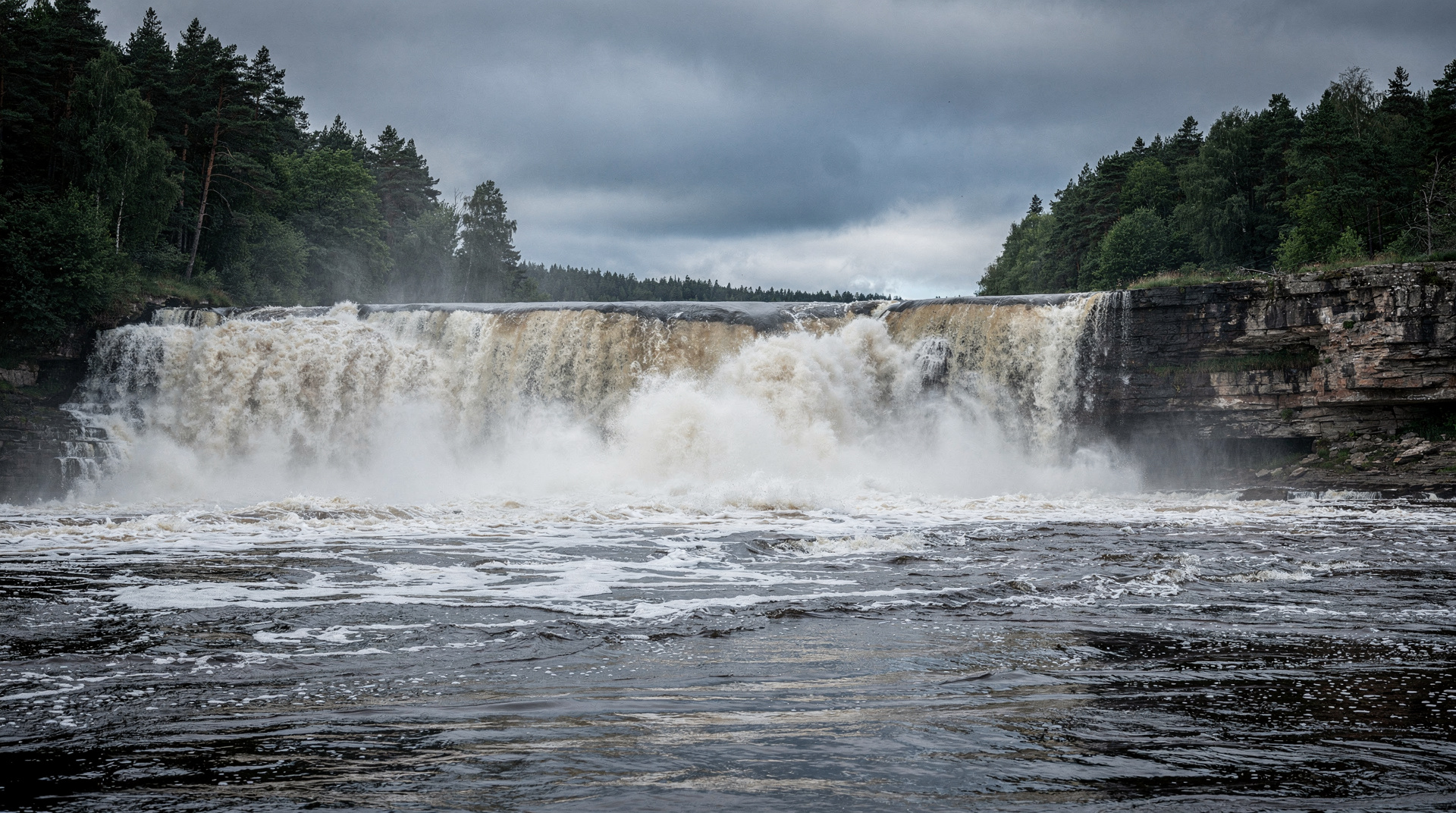
The main draw is both more and less dramatic than you expect. At 249 metres wide, Ventas Rumba (rumba means “waterfall” or “rapids” in Latvian) is technically Europe’s widest natural waterfall. The drop is only 1.5 metres at most — this is not Niagara. But standing on the 17th-century bridge looking upstream at a 250-metre curtain of water cascading over a natural basalt shelf, with the wooded valley banks rising on either side, is genuinely spectacular in its way.
The flying fish: From late April through May, vimba (Vimba vimba — a freshwater cyprinid fish in the carp family) migrate upstream to spawn. To get past the waterfall, they leap directly over it — hundreds of fish visibly jumping up through the falling water in a kind of silvery chaos. This spectacle is genuinely unusual and historically documented in Kuldīga for hundreds of years. Local fishermen traditionally caught the jumping fish with baskets held over the falls. Today it is protected and photographed rather than harvested.
In winter: Ventas Rumba partially or fully freezes in cold winters, creating a striking ice formation across the full width of the river. Worth seeing if you are in Kuldīga between December and February, but entirely dependent on temperatures.
The Kuldīga brick bridge (Venta bridge)
The pedestrian bridge just upstream of the waterfall was built in 1619 by order of Wilhelm Kettler, Duke of Courland. At 164 metres long, it is one of the longest surviving historical brick road bridges in northern Europe. The combination of the bridge’s brick arches, the waterfall just downstream, and the wooded valley banks is photogenic in almost any light.
Walking across the bridge and back takes 10 minutes. From the far bank, the classic view back toward the old town and waterfall is the best photograph you will take in Kuldīga.
The old town
Kuldīga’s old town is a rare surviving example of a 17th-18th century Latvian market town — the type of urban settlement that developed across the Duchy of Courland but was mostly destroyed or radically altered in the 19th and 20th centuries. The main square (Rātslaukums) is flanked by the town hall (1860s), several merchant houses, and the St Catherine’s Lutheran Church (1640s, substantially rebuilt).
The surrounding streets have wooden buildings from the 18th and 19th centuries — not individually grand, but collectively remarkable in their density and state of preservation. Walk:
Baznicas iela east from the square toward the Alekšupīte stream valley — the stream flows through a small gorge below street level, with wooden bridges and a series of small waterfalls (the Alekšupīte rapids, much smaller than Ventas Rumba but charming).
Kalna iela north toward the ruins of the Livonian Order castle hill (not much survives above ground, but the hilltop viewpoint is worthwhile).
The Kuldīga Museum (Pils iela 5): Housed in a restored 18th-century building, covering the history of the Duchy of Courland and the town’s development. Entry €4. Worth 45 minutes if the region’s history interests you.
The Alekšupīte stream and old town craft workshops
The Alekšupīte stream runs through a small wooded gorge below the old town and rejoins the Venta near the waterfall. A walking path follows the stream for about 1 km, passing small workshops and studios that have set up in old utility buildings along the bank — a ceramics studio, a woodworking workshop, a small gallery. The area has a quiet, unforced charm.
The broader Courland region
Kuldīga is the base for exploring Kurzeme — the western peninsula of Latvia with a distinct character developed under the Duchy of Courland (1562–1795). The Courland dukes were remarkable rulers who built colonies in Gambia and Tobago in the 17th century, sponsored Rastrelli’s design of Rundāle, and maintained a sophisticated court culture.
Other Courland destinations accessible by car from Kuldīga:
Sabile (25 km east): A tiny hillside town with a wine terrace that produces genuine Latvian wine — the northernmost outdoor commercial vineyard in Europe. The wine is dry and acidic but fascinating as an anomaly. The Sabile wine hill (Sabiles vīna kalns) is open for visits in summer.
Talsi (40 km north): A more substantial town with a lake and a local history museum, less visited than Kuldīga but with a pleasant lakeside setting.
Sample itinerary
8:00 — Depart Riga (guided tour pickup or own vehicle). 10:00 — Arrive Kuldīga. 10:00–11:30 — Ventas Rumba waterfall and brick bridge walk. 11:30–13:00 — Old town walk: Rātslaukums, Baznicas iela, Alekšupīte stream path. 13:00 — Lunch in old town (Venta cafe or Pastnieks restaurant). 14:00 — Kuldīga Museum (optional, 45 min). 15:00 — Depart for Riga (or continue to Sabile if on own wheels). 17:00–18:00 — Return to Riga.
Honest tips
Distance matters: 165 km west is significantly further than Sigulda (50 km) or Jūrmala (25 km). Build in sufficient driving time and do not try to rush the return in evening traffic on the single-carriageway A9.
Flying fish timing: If the vimba spectacle is the specific reason for your trip, aim for late April to mid-May. This is the reliably active period for the upstream migration, though exact timing varies with water temperature year to year.
Photography: The waterfall, bridge, and old town photograph best in morning light (before 11am). Afternoon sun is directly overhead and slightly harsh on the stone and wood textures.
Crowds: Kuldīga is significantly less crowded than Sigulda even in peak summer. You may have the waterfall largely to yourself on a weekday morning. Weekends in July bring day-trippers from Riga and Liepāja.
Latvian wine: If you add Sabile, the wine is genuinely interesting to taste — the Latvian maritime climate produces a white that is sharp and slightly herbal. Do not expect Burgundy; do expect something genuinely unusual and locally made.
Frequently asked questions
Is Ventas Rumba accessible year-round?
Yes. The path to the waterfall is accessible in all seasons. In winter, it may be partially frozen (which is striking). In spring, the fish spectacle adds extraordinary interest. In summer, the water volume is lower but the setting is beautiful.
What is the drive like from Riga to Kuldīga?
The A9 motorway runs from Riga through Jelgava and Saldus; the final section on regional roads P112/P108 is two-lane and rural. The drive is straightforward but requires attention on the regional roads — other vehicles are infrequent but road conditions vary.
Is there accommodation in Kuldīga?
Yes — several small hotels and guesthouses in and around the old town. Staying overnight gives you the evening light on the waterfall and the old town in morning quiet before day-trippers arrive.
How Kuldīga compares to Riga’s other day trips
At 165 km, Kuldīga is the farthest of the standard Riga day trips, further than Rundāle Palace (75 km), Sigulda and Gauja National Park (50 km), or Ķemeri National Park (40 km). That distance is the honest trade-off: Kuldīga delivers a genuinely different, less-visited slice of Latvia, but it costs a longer day and a higher tour price than the closer options.
For a full ranked comparison of every option, see best day trips from Riga. If your schedule only allows one western Latvia trip, Kuldīga’s UNESCO old town and the flying-fish spectacle make a stronger case than most; if you want the shortest, easiest win, Jūrmala or Ķemeri cost far less time.
For travellers building a full west-Latvia route, Bauska Castle sits en route between Riga and Rundāle rather than toward Kuldīga, so it does not combine naturally with this trip — plan it as part of the Rundāle day instead. Check Riga weather month by month before committing to a date, since the driving-heavy itinerary is far more pleasant in dry conditions.
Can you visit Kuldīga and Rundāle on the same day?
They are in opposite directions from Riga (Kuldīga is 165 km west, Rundāle is 75 km south), so combining them in a single day would require very early departure and result in a rushed, exhausting trip. Better to dedicate separate days to each.
Frequently asked questions about Kuldīga and Courland day trip from Riga
What is Ventas Rumba?
Is Kuldīga worth the distance from Riga?
When should you visit Kuldīga?
How long does it take to explore Kuldīga?
What is the Kuldīga brick bridge?
Top experiences
Bookable activities with verified prices and instant confirmation on GetYourGuide.