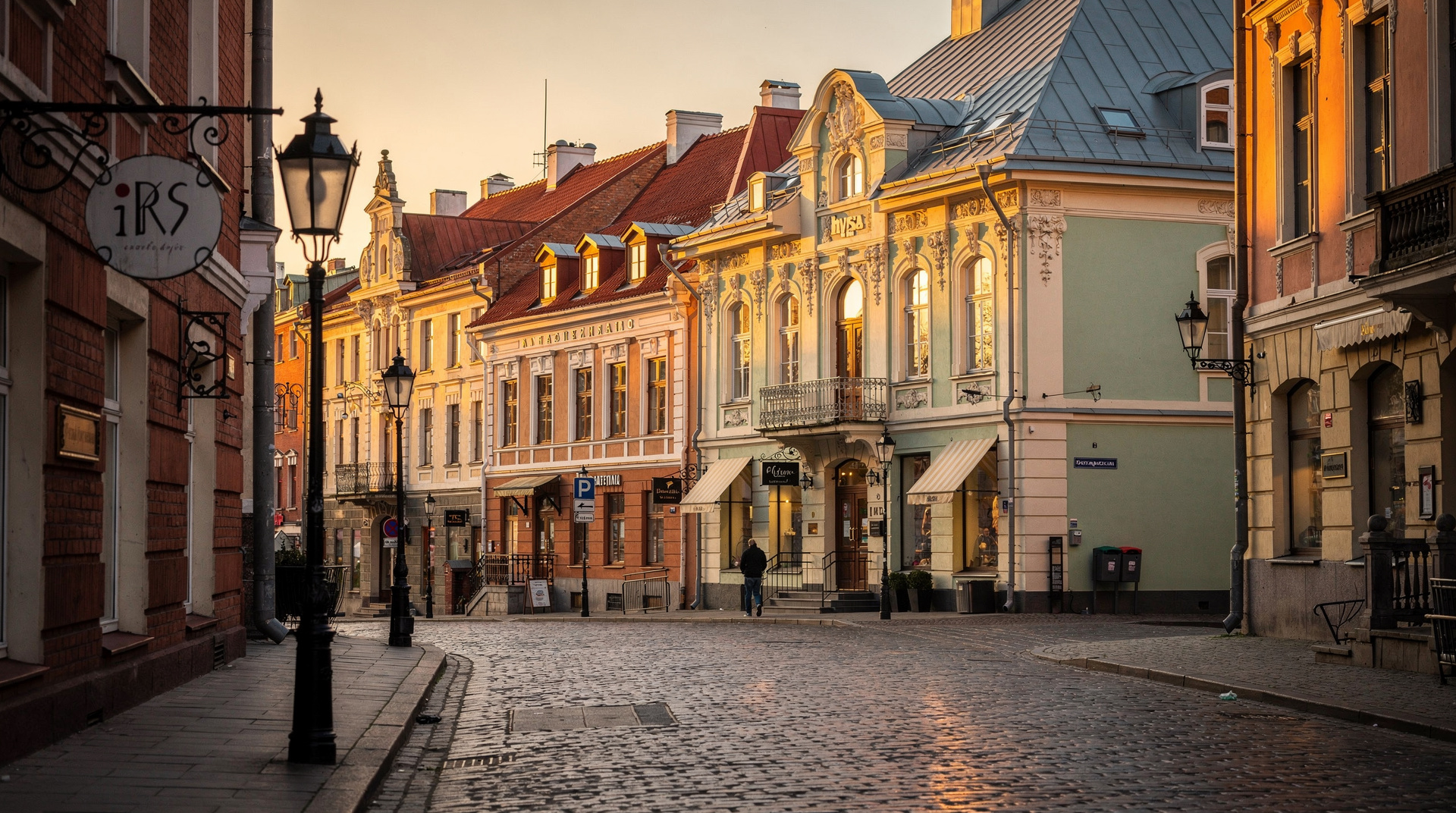
Riga Quiet Center embassy quarter: a neighbourhood guide
The residential streets beyond Alberta iela: embassies in Art Nouveau villas, Esplanāde park, and the dignified calm of central Riga's west side.
Riga: 2-hour history of Art Nouveau walking tour
Duration: 2 hours
- Free cancellation
- Small group
Quick facts
- Key streets
- Antonijas iela, Raiņa bulvāris, Brīvības iela, Tērbatas iela
- Esplanāde park
- Large central park with the National Museum of Art
- Embassy character
- Many embassies occupy historic Art Nouveau villas
- Best transport
- Walk from Old Town (15 min) or from Alberta iela (5 min)
- Café anchor
- Rocket Bean Roastery, Miera iela 31 (5 min walk)
The Quiet Center beyond the famous streets
Most visitors to Riga’s Art Nouveau district begin and end on Alberta iela and Elizabetes iela — the two streets most frequently featured in architectural photography. These streets deserve their reputation. But the Quiet Center (Klusais centrs) extends significantly beyond them, and the streets less frequented by tourists offer a different kind of encounter with the city: the institutional Riga of embassies and consulates, the civic Riga of the Esplanāde park and the National Museum of Art, and the residential Riga of tree-lined streets where the architecture is slightly less theatrical but architecturally no less interesting.
This is not a destination that rewards a rushed itinerary. It is a neighbourhood for slow walking — the pleasure is cumulative, built up over 30-minute stretches of careful observation. The appropriate audience is visitors who have already covered the Old Town and Alberta iela and want to understand how the rest of central Riga fits together.
What to see and do
The embassy streets: Antonijas iela, Raiņa bulvāris, and Tērbatas iela
Running roughly parallel to Alberta iela but further west and south, these streets concentrate a remarkable number of diplomatic missions in restored historic villas. The architecture is a mixture of late Art Nouveau, National Romanticism, and early functionalism from the 1900s–1930s — the buildings are somewhat more restrained than Eisenstein’s exuberant facades on Alberta iela, but the quality is consistently high.
Antonijas iela, running perpendicular to Alberta iela toward Esplanāde, has several fine embassies in well-maintained historic buildings. Raiņa bulvāris — the wide boulevard bordering the Esplanāde park — has institutional buildings from the First Republic period (1918–1940) alongside the National Museum of Art. Tērbatas iela and the cross-streets connecting these boulevards form the fabric of the embassy quarter proper.
The experience of walking here is that of a working diplomatic zone rather than a tourist attraction: the streets are quiet, the buildings are well-maintained but not accessible, and the occasional flag above a restored Art Nouveau portal is the main indicator of function. It is architectural observation as a quiet activity.
Esplanāde park and the National Museum of Art
The Esplanāde (formally: Jēkaba laukums) is a large open park between Raiņa bulvāris and Krišjāņa Valdemāra iela, and it serves as the green transition zone between the commercial centre and the embassy/residential areas. The park contains pavilions, a fountain, and areas for casual sports; in summer it is where Riga office workers eat lunch on benches.
The Latvian National Museum of Art (Latvijas Nacionālais mākslas muzejs) on Raiņa bulvāris 10a is the most significant art institution in Latvia. The collection covers Latvian painting from the late 19th century to the present day — the Baltic-German romantic landscape tradition, the early-20th-century realists, Soviet-period painting, and contemporary Latvian work. The building itself (completed 1905) is a fine neoclassical work by the German architect Wilhelm Neumann. Entrance is approximately €5; closed Mondays. Allow 1–1.5 hours for a meaningful visit.
The broader Klusais centrs streetscape
Between Elizabetes iela to the south and Tērbatas iela to the north, between Brīvības iela to the east and Krišjāņa Valdemāra iela to the west, lies the core embassy quarter. The streets Stabu iela, Dzirnavu iela, Skolas iela, and their cross-streets form a calm residential grid with trees, 1900s–1930s apartment buildings, and occasional surprises — an unusually ornate doorway, a building with its original tile work intact, a courtyard visible through open gates.
The Corner House (Stūra māja) at Brīvības iela 61 — the former Soviet KGB headquarters — marks the eastern boundary of this area and is covered in the Central Market and Maskavas Forštate guide (the Soviet history is shared between guides). It is worth including in a walk through this quarter if you have not seen it separately.
Art Nouveau tours covering this area
The Art Nouveau history walking tour is the most efficient guided introduction to this district. It covers Alberta iela and Elizabetes iela in most versions, but the better guides extend the route into the surrounding streets where the architectural range is wider.
Book the 2-hour Art Nouveau history walking tour (€22, small group)The architecture bike tour covers the embassy quarter streets in a broader cycling route that also takes in Ķīpsala, Āgenskalns, and the Art Nouveau district — the best way to understand the geographic relationship between these neighbourhoods.
Book the architecture and districts bicycle sightseeing tour (€32, 3 hours)Best places to eat and drink
The embassy quarter itself is residential and has fewer cafés than the Art Nouveau district proper. The best options are a short walk away.
Rocket Bean Roastery (Miera iela 31, 5–8 minutes’ walk north) — the best specialty coffee in Riga, with a solid food menu. The Miera iela neighbourhood around it is the most interesting café and independent-shop street in the city. A full coffee and lunch: €10–14.
Kafejnīca Osiris (Skolas iela) — a quiet neighbourhood café within the embassy quarter, good for coffee and cake during a walking pause. Low-key, no tourist menu.
Lido Vermanis (Elizabetes iela 65, south side of the quarter) — the Latvian self-service canteen chain at its best. Traditional Latvian food, honest prices (€6–9 for a full plate), and always busy with local workers at lunch. The definitive antidote to Old Town tourist pricing.
Miera iela neighbourhood generally: the 10-minute walk from the embassy quarter to Miera iela (heading north past Tērbatas iela) passes through a zone of independent cafés, design shops, and restaurants that represent the aspirational local Riga of the 2020s. No tourist infrastructure, no English-only menus, and prices that make the Old Town look expensive.
Getting to the embassy quarter
On foot from Old Town: follow Brīvības iela or Elizabetes iela north-west from the canal boundary of Old Town. The Art Nouveau district begins immediately outside the canal ring; the embassy quarter is a further 5–10 minutes’ walk into the same area. Total: 15 minutes from Old Town’s western edge.
On foot from Alberta iela: the embassy quarter streets begin immediately beyond Alberta iela’s northern end — 5 minutes to reach Antonijas iela.
By tram: Tram 11 (Elizabetes iela stop) or trams 6/11 on Brīvības iela. €1.15 with the Rīgas Satiksme card.
By Bolt: approximately €5–6 from Old Town, 3–5 minutes.
Honest tips for visiting this area
This is the complement to Alberta iela, not the substitute: do not come here instead of Alberta iela — come after it, to extend the picture. The embassy quarter lacks the dramatic set-pieces of Eisenstein’s work and requires a different attentiveness: reading the less theatrical but equally accomplished architecture of the 1900s–1930s.
Embassies are working buildings: some of the most photogenic villas are diplomatic missions with security. Photograph from the street and do not attempt to enter without appointment. Most buildings have no public access.
The National Museum of Art is often overlooked by tourists: Riga’s most important art institution is a 20-minute walk from Old Town and is consistently less visited than the Occupation Museum or the Art Nouveau Museum. If Latvian art from the last 150 years interests you, this is the place to see it. The collection is strong and the building is excellent.
The neighbourhood is safe and pleasant at all hours: this is one of the calmest and safest areas of central Riga. Evening walks in summer — long, slow Riga evenings with sunset after 22:00 at the solstice — are genuinely pleasant along these streets.
Combine with Miera iela for a full half-day: walk the embassy quarter streets (1 hour), visit the National Museum of Art (1–1.5 hours if it interests you), then continue north to Miera iela for coffee and a browse of the independent shops. That is a satisfying half-day that shows you a Riga that most visitors miss entirely. See our Art Nouveau architecture guide for a self-guided walking route that covers both areas.
Alberta iela vs the embassy quarter: setting expectations
Visitors who loved Alberta iela sometimes head into the embassy quarter expecting more of the same and come away disappointed, simply because they arrive with the wrong expectation. The honest comparison:
| Alberta iela / Elizabetes iela | Embassy quarter (Antonijas/Raiņa/Tērbatas) | |
|---|---|---|
| Ornament level | Maximalist, theatrical (Eisenstein) | Restrained, varied period styles |
| Crowd levels | Busy with tour groups by midday | Genuinely quiet at all times |
| Photography | Iconic, widely photographed facades | Subtler, more rewarding for patient photographers |
| Time needed | 1.5–2 hours | 45–90 minutes |
| Best visited | First, for the headline sights | Second, to deepen the picture |
Set the expectation correctly and the embassy quarter becomes genuinely rewarding rather than a letdown: it is the “read the small print” version of the Art Nouveau story, not a second dose of the same spectacle.
Think of the two areas as sequential chapters rather than competing options. Alberta iela delivers the immediate visual impact that photographs well and satisfies a first-time visitor’s expectation of “Riga Art Nouveau.” The embassy quarter rewards a slower, second pass — the kind of visit where you notice a building’s proportions and materials rather than its most dramatic single feature. Visitors pressed for time should always prioritise Alberta iela; visitors with a full extra day, or repeat visitors returning to Riga, get proportionally more out of the embassy quarter than a third pass along the famous street would offer.
Walking Raiņa bulvāris and the Esplanāde in context
Raiņa bulvāris deserves particular attention because it tells a different chapter of Riga’s history from the merchant-driven Art Nouveau boom on Alberta iela. The institutional buildings here — many constructed or repurposed during the First Republic period of 1918–1940 — reflect Latvia’s brief interwar independence and the civic ambitions of a young state building its own museums, ministries and cultural institutions before the Soviet occupation interrupted that project in 1940.
Walking from the Esplanāde park past the National Museum of Art and along Raiņa bulvāris gives a physical sense of that interrupted national narrative in a way that reading about it does not. The Museum of the Occupation of Latvia in Old Town provides the fuller historical context for what followed.
Frequently asked questions about Riga’s embassy quarter
What is the Quiet Center in Riga?
Klusais centrs (Quiet Center) is the name used locally for the residential and institutional districts immediately outside the Old Town canal ring — broadly the area between the canal and the railway line, west and north of Old Town. It encompasses both the famous Art Nouveau streets (Alberta iela, Elizabetes iela) and the broader embassy quarter described in this guide. It is called “quiet” in contrast to the commercial centre along Brīvības iela and the tourist-heavy Old Town.
Which embassies are in the Riga embassy quarter?
Several dozen diplomatic missions are located in the Klusais centrs area, many occupying historic Art Nouveau or National Romanticism villas. The specific locations change over time; the point for the visitor is the architectural quality of the buildings rather than their current institutional function. The British Embassy, German Embassy, Swedish Embassy, and several others have historically been in this area.
Is the Latvian National Museum of Art worth visiting?
Yes, if Latvian art interests you — which it may more than you expect once you see the collection. The 19th-century Latvian landscape tradition and the early 20th-century figurative painting are particularly strong, and the Soviet-period section provides useful context for understanding how Latvian cultural identity was maintained under occupation. The building is also worth seeing. Budget 1–1.5 hours.
How does the embassy quarter differ from the main Art Nouveau district?
The main Art Nouveau district (Alberta iela, Elizabetes iela) offers the most theatrical and internationally famous examples of Jugendstil architecture — specifically Eisenstein’s work. The embassy quarter has architectural richness of a different kind: wider streets, more varied stylistic range (National Romanticism, early functionalism, eclectic historicism alongside Art Nouveau), and a quieter institutional character. It is deeper rather than more dramatic, and rewards architectural knowledge rather than just visual impact.
Can I walk from the Old Town to the embassy quarter and back in half a day?
Comfortably. A circular walk from the Old Town western canal boundary to Alberta iela, through the embassy quarter streets to Esplanāde, and back via Brīvības iela takes about 2 hours at a relaxed pace. Add the National Museum of Art (1–1.5 hours) and a coffee on Miera iela (30 minutes) and you have a solid half-day. The self-guided walking routes guide has detailed suggestions for this itinerary.
What is the best time of day to walk the embassy quarter streets?
Early morning (before 09:00) and late afternoon (after 17:00) are optimal in summer — the streets are at their quietest, the light is best for photographing facades, and the atmosphere is most authentic. The wide streets of Raiņa bulvāris and Elizabetes iela have mature chestnut and lime trees that provide shade in summer and dramatic canopy in autumn. Avoid midday in July–August when the streets are busy with tour groups spilling over from Alberta iela and the light on north-facing facades is flat.
What architectural styles will I see in the embassy quarter?
The quarter is a textbook survey of Riga’s early-20th-century architectural moment in its full range. You will see: late Jugendstil (Art Nouveau) in the Eisenstein idiom, with applied sculptural ornament; National Romanticism, the Latvian-Baltic variant that draws on folk motifs, fortress-like masonry, and pitched roofs; early rationalism and proto-functionalism from the 1910s–1920s; and First Republic (1918–1940) classicising modernism, particularly on the institutional buildings around the Esplanāde.
This architectural layering reflects the city’s historical transitions — from Russian Imperial province to independent republic — over a compressed 50-year period. The Art Nouveau architecture guide explains how to read these styles in sequence.
Is there a good walking tour that covers the embassy quarter?
The Art Nouveau history walking tour covers the main Art Nouveau streets but does not always extend into the embassy quarter proper — it depends on the guide and the group’s pace. The architecture bike tour is more likely to cover the full spatial range, since cycling allows the guide to show the geographic relationships between Old Town, the Art Nouveau district, and the embassy quarter in a single 3-hour session. If you want to walk independently, the Riga self-guided walking routes guide has a specific circuit that takes in Antonijas iela, Tērbatas iela, and the Esplanāde without requiring prior architectural knowledge.
Are there any good restaurants or cafés specifically in the embassy quarter?
The embassy quarter is primarily residential and institutional, which means fewer cafés than the Art Nouveau district to the south. The best nearby option is Rocket Bean Roastery on Miera iela (a 5–8 minute walk north), which is widely considered the best specialty coffee venue in the city. Kafejnīca Osiris on Skolas iela is a quiet neighbourhood café within the quarter itself — good for a coffee break in the middle of a walk. For a proper lunch, Lido Vermanis on Elizabetes iela (south-east edge of the quarter) offers traditional Latvian food at canteen prices — grey peas with bacon, stuffed cabbage rolls, cold meats and pickles — for €6–9 per person, which is the most honest meal you will find this close to the tourist centre.
How is the Quiet Center changing?
The area has been gradually gentrifying since the mid-2010s, particularly around Miera iela and Avotu iela to the north, which have developed a concentration of independent cafés, boutiques, and design studios. This represents a genuine change from a decade ago when the streets north of Tērbatas iela were characterised mainly by residential buildings and occasional neighbourhood shops. The embassy quarter itself is more stable — the diplomatic use of the historic villas provides strong maintenance incentive and prevents the deterioration that affects some other central Riga streets.
The Esplanāde park has been renovated and is better maintained than it was in the early post-Soviet period. Overall the trajectory is positive for the visitor experience, though the same gentrification that improves the cafés also raises rents and pushes out the independent shops that gave the area character. The tension is familiar from every European city neighbourhood on this trajectory.
Is the embassy quarter a good place to stay in Riga?
One of the best, particularly for travellers who value quiet, authenticity, and architecture. The streets are calm at night, the buildings are beautiful, and the location is excellent — 15 minutes’ walk from Old Town, 5 minutes from Alberta iela, and on the tram line north toward Mežaparks. Hotel prices are 20–35% lower than equivalent properties in Old Town. The trade-off is that you are further from the nightlife concentration (though for most visitors this is not a trade-off at all). For recommendations on specific streets and properties, see our guide to staying in the Art Nouveau district vs Old Town.
How does the embassy quarter connect to Andrejsala and Ķīpsala?
Both are quieter, second-layer Riga neighbourhoods, but they sit on opposite sides of the centre and have different characters — the embassy quarter is inland, institutional and architectural; Andrejsala and Ķīpsala are riverside, residential and post-industrial. They do not connect directly on foot within a short walk, so treat them as separate half-day outings rather than trying to combine them in one loop unless you have a bike and a full day free.
Is the embassy quarter suitable for a rainy-day visit?
Partly. The architecture-focused street walking loses some of its appeal in heavy rain, but the National Museum of Art is an excellent indoor alternative that fits naturally into the same visit — start with the museum if rain is forecast for the morning, then walk the streets if conditions improve later in the day.
Top experiences
Bookable activities with verified prices and instant confirmation on GetYourGuide.