
Ķemeri National Park
Kemeri National Park visitor guide: the sulfur bog boardwalk, birdwatching, mineral springs and how to reach this otherworldly landscape from Riga.
From Riga: Ķemeri bog boardwalk and seaside Jūrmala
Duration: 6 hours
- Small group
- Free cancellation
Quick facts
- Distance from Riga
- 45 km west
- Train to Ķemeri station
- ~45 min from Riga Central
- Train fare
- ~€2.50 one way
- Boardwalk length
- 3.4 km loop
- Entry fee
- Free
A bog that feels like another planet
Ķemeri National Park is one of Latvia’s most distinctive natural environments and one of the most underrated half-day destinations reachable from Riga. The park was established in 1997 and covers approximately 38,000 hectares of the Latvian coast south of Jūrmala, encompassing a remarkable range of habitats: raised peat bogs, coastal sand dunes, alkaline fens, sulphur spring networks, lakes and marshes, and patches of old coastal forest.
This biodiversity is exceptional and is the reason the park carries both national and international protected area designations. The centrepiece is the Great Ķemeri Bog (Lielais ķemeru tīrelis) — a raised peat bog that formed over 10,000 years since the last ice age and looks, in the right morning light, like a moonscape: flat, open, strangely silent, dotted with rust-coloured pools reflecting the sky and small pine trees bent into sculptural shapes by decades of wind.
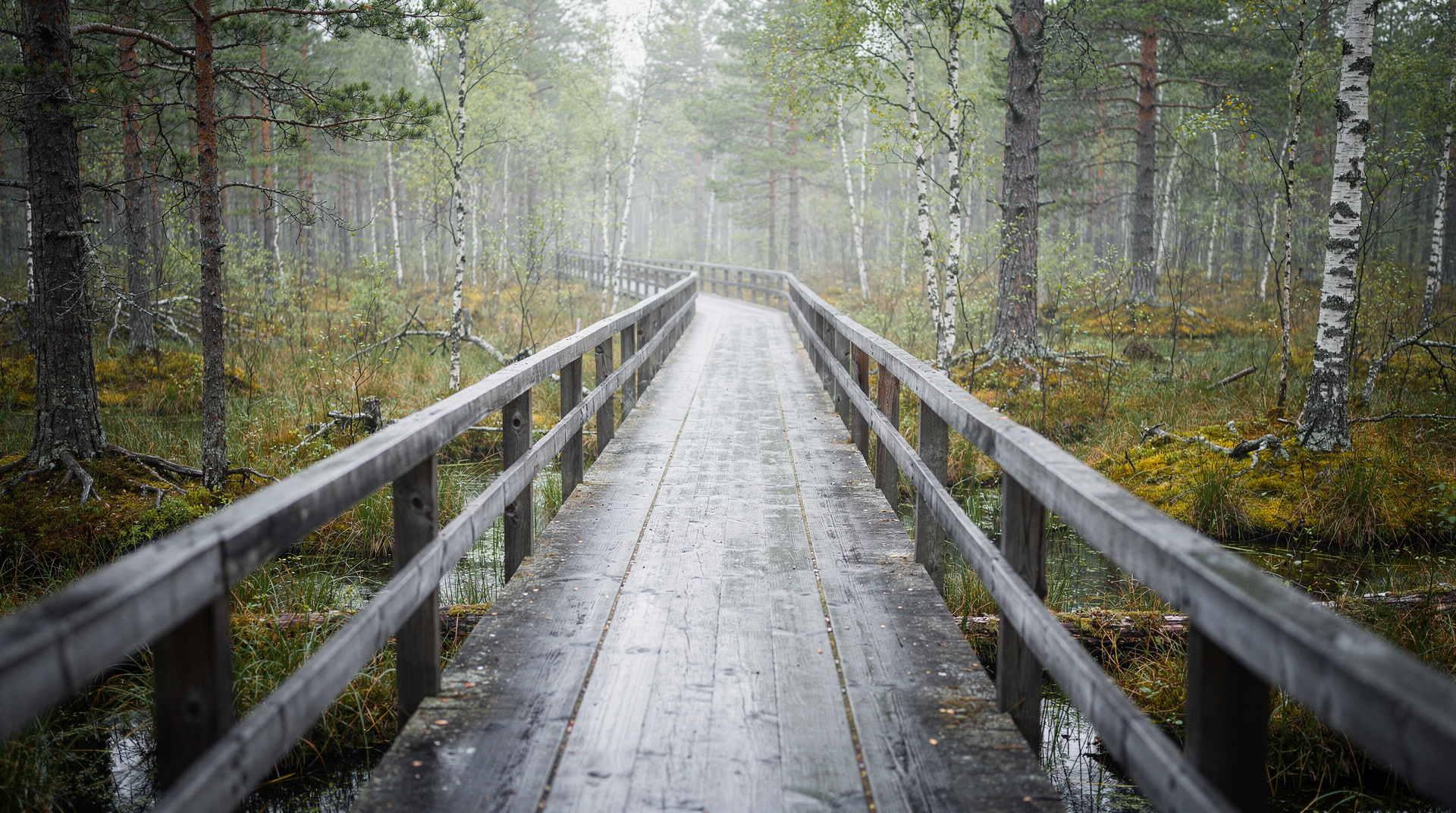
The bog boardwalk (approximately 3.4 km loop) is the main visitor route. It is entirely flat, surfaced with wooden planks, and suitable for most fitness levels including older visitors and families with pushchairs on the standard model. The boardwalk rises to an observation tower about halfway around that gives a 360-degree view across the bog — one of the most striking landscapes in the country and, on a clear day, a view that extends to the coastline.
Beyond the bog, Ķemeri National Park encompasses sulphur springs, mineral-rich streams, marshy meadows and patches of old forest. The area has historically been known as a spa destination — the Grand Hotel Ķemeri (a magnificent Art Deco building from the 1930s, now being slowly restored) stands as a reminder of when the sulphur waters drew visitors from across the Baltic region.
The raised bog itself — the Lielais ķemeru tīrelis, or Great Ķemeri Bog — is a classic example of an ombrotrophic raised mire: a convex dome of peat that has accumulated over thousands of years and is now raised above the surrounding landscape, fed exclusively by rainwater and supporting only the specialist plants that can survive in nutrient-poor, acidic, waterlogged conditions.
The visual result is extraordinary: a flat, open, minimalist landscape of low sphagnum moss, bog cotton, sundew, small contorted pines and dark, still pools. On a grey autumn morning the scene can feel primordial and slightly unsettling. On a bright June day with cottongrass in flower it is luminous and otherworldly. Either way, it is unlike anything most visitors have seen before.
The ecology of the bog is interesting even for visitors without a scientific background. The carnivorous sundew plants (Drosera species) are visible on the boardwalk edge if you look closely — tiny rosettes of reddish leaves covered in sticky glandular hairs that trap and digest insects. The bog pools support specific dragonfly species. The sphagnum mosses form the basis of the whole system, their partially decomposed remains building the peat that gives the bog its raised form.
| Where | 45 km west of Riga, adjoining Jūrmala |
| Cost | Free entry; boardwalk always accessible |
| Time needed | Half day (1.5–2 hrs for the boardwalk loop) |
| Getting there | Train to Ķemeri station (~45 min) |
| Best time | April–October; autumn for colour and fewer mosquitoes |
From Riga: Ķemeri bog boardwalk and seaside Jūrmala
- Small group
- Free cancellation
What to see and do in Ķemeri
The Great Bog boardwalk
The primary reason to come to Ķemeri. The boardwalk starts from a car park and trailhead about 2 km south of Ķemeri village (signs point the way from the station). Allow 1.5–2 hours for the full loop at a relaxed pace, including time at the observation tower. The boardwalk is free of charge and open year-round.
Photography here is exceptional in early morning when mist sits in the hollows between the bog pools, or in autumn when the sphagnum moss turns deep red and amber. In spring (April–May), white cottongrass flowers create a visual effect unlike anything else in Latvia.
Wildlife to look for: white-tailed eagle (common overhead), crane, black stork, various waders. Mosquitoes are present from May to August — bring repellent.
Sulphur springs and the spa town
The village of Ķemeri has a distinct spa-town character left over from its 19th and early 20th century heyday as a health resort. The Grand Hotel Ķemeri is a listed building (and an ongoing restoration project) worth seeing from the outside even if it remains closed to visitors. The sulphur springs themselves — smelling of hard-boiled eggs, which is simply what sulphur water does — can be found along the walking trails near the village.
Combination with Jūrmala
Many visitors combine Ķemeri with Jūrmala on the same day: arrive in Jūrmala by mid-morning, walk the beach and Jomas iela until lunch, then take the train one stop west to Ķemeri for the afternoon bog walk. This works well and makes efficient use of a single day. The Pasažieru Vilciens train from Majori to Ķemeri takes about 15–20 minutes.
Jūrmala and Ķemeri National Park: full-day tour
- Hotel pickup
- Free cancellation
Birdwatching
Ķemeri is one of Latvia’s premier birdwatching sites, particularly during spring and autumn migration. The Lake Kaņieris, which borders the national park’s northwestern edge, is a Ramsar-listed wetland hosting breeding populations of bittern, marsh harrier, great reed warbler and — in good years — white-tailed eagle nesting nearby. The forest and bog edges are excellent for breeding warblers and flycatchers in spring.
The Ornithological Nature Trail (starting from the park visitors’ centre in Ķemeri village) is a 4 km loop optimised for birdwatching, with information boards in Latvian and English.
The spring migration period (late April to May) is particularly rewarding. Tens of thousands of waders, wildfowl and raptors pass through the coastal zone adjacent to the park during migration. The lake shores at dusk during this period can produce sightings of up to 30 species in an evening. The Latvian Ornithological Society (LOB) runs regular guided birdwatching events in the park during peak migration; details at putni.lv.
The bog itself supports breeding populations of golden plover, common snipe and — in years when water levels are right — short-eared owl hunting over the open bog surface in broad daylight. Crane families are resident and highly visible from the boardwalk tower in late summer when the juveniles are on the wing.
Sulphur springs and the historic spa district
Ķemeri village has a specific character rooted in its history as a 19th-century health resort. The mineral sulphur springs were known to the local population long before the resort developed, but it was in the 1830s that the Russian imperial authorities began developing Ķemeri as a formal spa town. By the end of the 19th century, the sulphur baths were attracting several thousand visitors annually, and Ķemeri had a status comparable to the spa towns of central Europe.
The Grand Hotel Ķemeri — a massive Art Deco building from 1936, designed by Eižens Laube — was the centrepiece of the pre-war resort. After independence from the Soviet Union, it fell into disuse and has been in various states of restoration and vacancy ever since. As of 2026, the exterior has been stabilised and is impressive to view from the grounds. The restoration is expected to continue for several more years before any public access is restored. Do not enter — it is a live construction site.
The sulphur springs themselves are accessible via trails from the village centre. The water smells strongly of hydrogen sulphide (the “rotten egg” smell associated with all sulphur springs). It is harmless; the smell dissipates quickly when you move away.
Kemeri–Kuldīga combined tour
For a more ambitious day trip covering both the bog and the UNESCO medieval town of Kuldīga to the west, guided tours from Riga cover both in a single long day.
From Riga: Ķemeri National Park and Kuldīga combined tour
- Small group
How to get to Ķemeri from Riga
By train
Take the Pasažieru Vilciens Tukums line from Riga Central Station to Ķemeri station. Journey time is approximately 45 minutes; fare is around €2.50. Trains run roughly hourly — check the current timetable at pv.lv. From Ķemeri station, the village centre and the Grand Hotel are a short walk (5 minutes). The boardwalk trailhead is about 2 km south; you can walk it in 25 minutes or take a taxi from the station (around €5–7).
Returning: last trains back to Riga leave Ķemeri in the early evening — check the return timetable before you set out, as trains are not as frequent as they are on the Jūrmala section.
By guided tour
Guided day trips from Riga that include the bog boardwalk, a guide who can explain the ecology and hydrology, and transport to and from your hotel are the most convenient option for visitors who don’t want to navigate the train and walking logistics alone.
From Riga: Jūrmala and Ķemeri National Park tour with picnic
- Picnic included
- Small group
By car
Driving from Riga takes about 45–55 minutes via the A10 motorway. Free parking is available at the bog trailhead and near the visitors’ centre. A car is useful if you want to combine Ķemeri with multiple other sites in the park or with a Jūrmala stop.
Where to eat near Ķemeri
There are no tourist restaurants inside the national park itself. The village of Ķemeri has a small shop. For a proper meal before or after the bog walk, eat in Jūrmala (Majori) before or after your visit. If you drive, the road towards Tukums has a small number of roadside cafés.
If you are doing the full loop with a picnic (highly recommended), Riga’s Central Market or any of the supermarkets near Riga Central Station (Maxima, Rimi) are good stops for provisions before the train.
Where to stay
Ķemeri is an easy half-day from Riga; staying overnight is not necessary for most visitors. The Ķemeri Hotel (a smaller property separate from the Grand Hotel) offers basic accommodation if you want to spend a full two-day immersion in the park. For the vast majority of travellers, base yourself in Riga and treat Ķemeri as the half-day outing it is. See the Jūrmala day trip page for options on combining both.
Honest tips for Ķemeri
Mosquitoes are serious from June to August. The bog environment breeds them in large numbers. Long sleeves, trousers and repellent (DEET-based is most effective) are non-negotiable from May through September if you want to enjoy the walk rather than endure it.
Train frequency drops significantly in the evening. If you take the late-afternoon train out from Riga, check the last return train time. Missing the last train back means a taxi from Ķemeri to Riga of about €40–50.
The boardwalk can be wet after rain. The bog is, by definition, a wet environment. Waterproof shoes or walking boots are strongly recommended. The wooden planks become slippery when wet.
The Grand Hotel Ķemeri restoration is ongoing. It is a magnificent building and worth seeing from the outside, but do not expect it to be open or accessible. Reports of “you can walk through the ruins” circulate online — this involves trespassing on a construction site and is not recommended.
Autumn is the best season. September and October bring golden and crimson bog colours, far fewer mosquitoes, crisp air and — especially on weekday mornings — near-total solitude. The photographs from this period are some of the most striking from anywhere in Latvia.
Bring your own water and snacks. Beyond the small shop in Ķemeri village, there is nowhere to buy food or drink near the boardwalk itself. A packed lunch or picnic, eaten either before setting out or at one of the benches along the route, works far better than hoping to find something on site.
Early risers get the best of it. Because the bog is genuinely photogenic in low, angled light and the wildlife is most active in the first hours after sunrise, an early train from Riga (before the day’s heat and the midday tour groups arrive) rewards visitors with both better photographs and a quieter, more contemplative walk.
Planning your Ķemeri visit
Combining Ķemeri with Jūrmala: the ideal itinerary
The most popular and efficient way to visit Ķemeri from Riga is to combine it with a Jūrmala stop in the same day. A practical itinerary: take the Pasažieru Vilciens train from Riga Central to Majori in Jūrmala (20–25 minutes, €2). Walk Jomas iela, have coffee and a pastry, explore the beach and the villa streets for 2–3 hours. Return to the Majori train platform and take the next train one further stop west to Ķemeri (15–20 minutes, the fare increment is minimal). From Ķemeri station, walk to the bog trailhead (25 minutes) or take a taxi (€5–7). Walk the full bog boardwalk loop (1.5–2 hours). Return to Ķemeri station and take the train back to Riga.
This itinerary uses approximately 7–8 hours comfortably and covers both Jūrmala beach culture and the bog ecology. It requires no car, no advance booking (unless you want a guided tour), and costs under €10 in transport. It is one of the best value days available from Riga.
What to wear and bring for the bog
The bog boardwalk presents specific challenges that are worth preparing for:
- Footwear: Waterproof shoes or trail boots are strongly recommended. The boardwalk planks become slippery when wet, and the margins of the path are wet bog year-round. Even in dry summer weather, the substrate immediately adjacent to the boardwalk is permanently waterlogged.
- Insect repellent: DEET-based repellent is the most effective. Apply it generously to all exposed skin before starting the walk if visiting between May and September. Mosquito nets over the head are not overkill in July.
- Sunscreen: The open bog has no shade. In summer the UV index can be high even on slightly cloudy days.
- Binoculars: Particularly useful at the observation tower for scanning the bog surface for birds. White-tailed eagles are often visible as specks above the treeline in the distance.
- Camera: The light at the bog is unusual — it bounces off the water surfaces and creates a bright, even quality that works well for landscape photography even at midday. The tower gives a 360-degree view that is best captured with a wide-angle lens.
The Ķemeri–Jūrmala guided tour option
For visitors who want interpretation alongside the nature experience, guided tours from Riga that cover both the Jūrmala resort history and the Ķemeri ecology in a single day are excellent value. The guide’s ability to explain the bog hydrology, identify birds and plants, and contextualise the history of the sulphur spa gives the visit a depth that independent travellers rarely achieve on a first visit.
See the Jūrmala day trip guide for how Ķemeri fits into a broader coastal day trip from Riga.
Accessibility
The main bog boardwalk is largely accessible to people with limited mobility. The plank surface is reasonably even and wide enough for a wheelchair or pushchair with large wheels, though the observation tower itself has wooden steps that are not wheelchair-accessible. The Ornithological Trail and other secondary trails are not surfaced and are not accessible for wheelchairs or standard pushchairs. Contact the park visitor centre in advance if you have specific mobility requirements.
Frequently asked questions about Ķemeri National Park
How long does the Ķemeri bog boardwalk take?
The full 3.4 km loop takes approximately 1.5 to 2 hours at a comfortable walking pace with stops at the observation tower and for photos. Allow 2.5 hours if you are a keen photographer or birdwatcher. The path is flat and the surface is good.
Is the boardwalk free?
Yes. There is no entrance fee to access the Lielais ķemeru tīrelis boardwalk. The car park and trailhead are open year-round. Guided tours that include the boardwalk will charge their tour price.
Can I combine Ķemeri and Jūrmala in one day?
Yes — this is a popular and practical combination. A common itinerary is to spend the morning at Jūrmala beach and Jomas iela, then take the train to Ķemeri in the early afternoon for the bog walk, returning to Riga by early evening.
Is Ķemeri worth visiting if I’m short on time in Riga?
If you only have two or three days in Riga and are prioritising the Old Town and one classic day trip, Ķemeri is not the first choice — Sigulda or Jūrmala alone deliver more per hour spent. But if you have four or more days, or a specific interest in nature and photography, Ķemeri is one of the most distinctive half-days available anywhere near Riga and is easy to combine with Jūrmala rather than requiring a separate trip.
What wildlife can I see in Ķemeri?
White-tailed eagle, crane, great bittern, black stork, marsh harrier, various waders in season, common lizard (often seen sunning on the boardwalk edge). Deer and wild boar are present in the forest sections but rarely seen on the main boardwalk. Adders (venomous but not aggressive) are present; watch where you step off the boardwalk.
Is the boardwalk pushchair-accessible?
The standard wooden plank boardwalk is accessible for modern pushchairs with larger wheels, but it requires some navigating around other visitors and the surface is not perfectly smooth. A baby carrier or backpack carrier is a more practical option with small children. Baby strollers with small wheels will struggle.
Do I need a car to reach Ķemeri?
No. The Pasažieru Vilciens train from Riga runs to Ķemeri station. From the station, the bog trailhead is 2 km away — walkable in 25 minutes, or a short taxi ride. However, a car gives you more flexibility to explore the more remote sections of the national park.
When is Ķemeri closed?
The bog boardwalk is accessible year-round. Some of the secondary trails can be impassable in late winter/early spring due to flooding and snow melt. The visitors’ centre has seasonal opening hours (check online before going in winter).
How does Ķemeri compare to Gauja National Park?
They are entirely different landscapes and not really comparable as a choice between one or the other. Gauja National Park is a river valley of sandstone cliffs, forest and castle ruins — varied terrain best explored over a full day or more. Ķemeri is a single, self-contained ecosystem — a raised bog — best absorbed in a focused 1.5–2 hour walk. Visitors with a serious interest in Latvia’s natural landscapes should see both; they showcase completely different sides of the country’s ecology, and neither substitutes for the other.
Ķemeri in context: bog, coast and spa history
Ķemeri’s location — sandwiched between Jūrmala’s beach resorts and the open countryside toward Tukums — gives it a slightly split identity that is worth understanding before you visit. It is simultaneously a national park (the bog, the lake, the forest), a faded 19th-century spa town (the Grand Hotel, the sulphur springs) and a practical rail stop on the Jūrmala line. Most visitors experience only the national-park side, which is the right call for a first visit, but the spa-town streets around the station are worth an extra 20–30 minutes if you have time — the contrast between the Art Deco grandeur of the Grand Hotel and the wild, empty bog just beyond it is part of what makes Ķemeri distinctive among Latvia’s protected areas.
Visiting with children or a wildlife-focused itinerary
The boardwalk’s flat, wide-plank surface and complete absence of steep terrain make it one of the easier nature walks in the Riga region for families, though children should be supervised near the open bog pools that flank sections of the path. For a more wildlife-focused visit, pair the boardwalk with the Ornithological Nature Trail and aim for early morning, when bird activity is highest and the light is best for photography. The best kid-friendly attractions in Riga guide and the Baltic Sea beaches near Riga guide both cover how a Ķemeri visit fits alongside beach time in Jūrmala for a family day out.
Top experiences
Bookable activities with verified prices and instant confirmation on GetYourGuide.
From Riga: Ķemeri bog boardwalk and seaside Jūrmala
- Small group
- Free cancellation
Jūrmala and Ķemeri National Park: full-day tour
- Hotel pickup
- Free cancellation
From Riga: Jūrmala and Ķemeri National Park tour with picnic
- Picnic included
- Small group
From Riga: Ķemeri National Park and Kuldīga combined tour
- Small group